
When two codes written by different people, on different meshes, arrive at the same torque, the result has earned some credibility. When both drift from the published number by the same amount, the question moves: the problem is no longer the code, it is the model.
The case
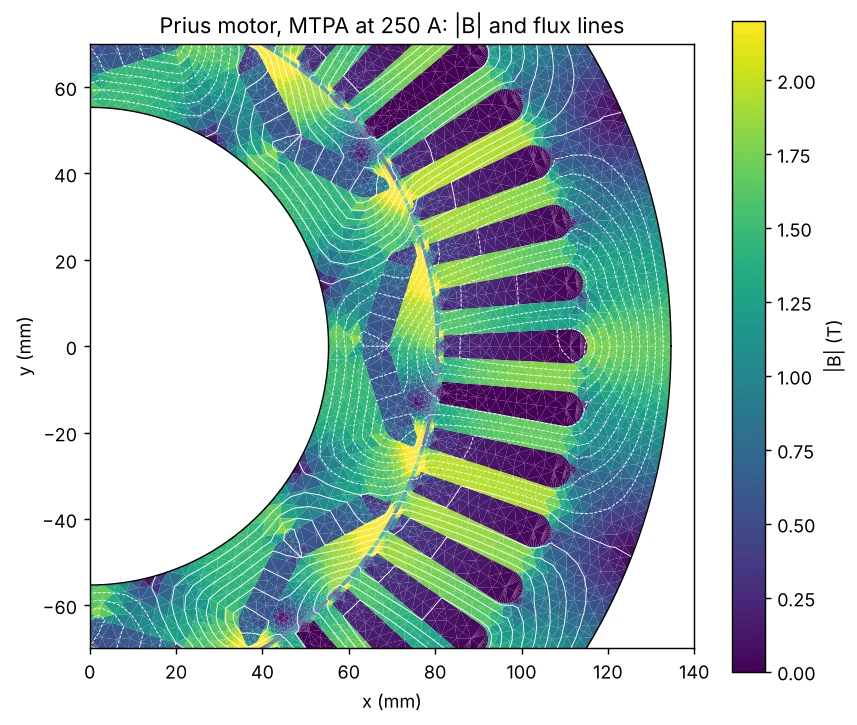
The geometry is the 2010 Prius motor, one of the most used open benchmarks in electrical machines. Our FEM solves the field in 2D; GetDP, an independent finite-element solver, solves the same problem on the same geometry. That is 12 rotor positions and 960 points along the air gap.
The numbers
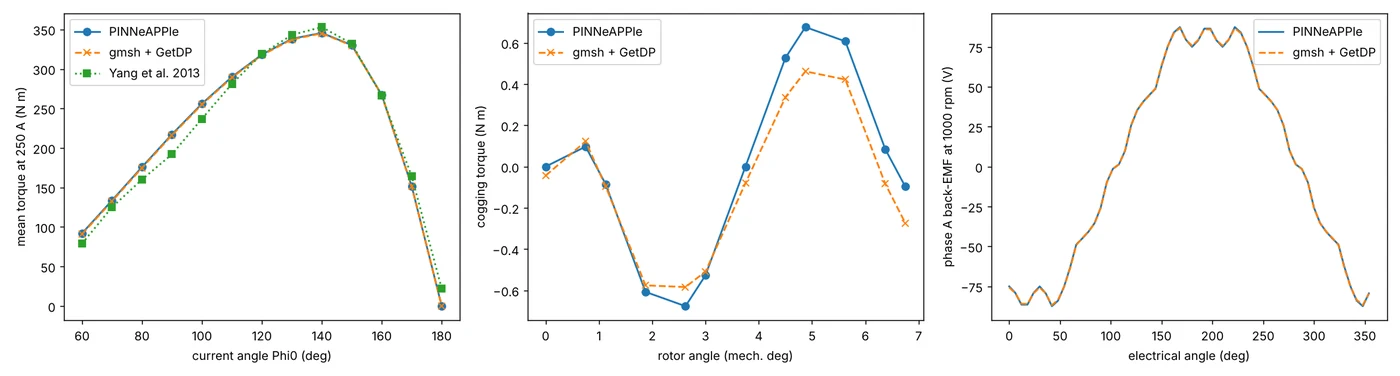
Maximum torque difference between the two: 1.09 N·m, or 0.19% at the peak, with an RMS of 0.81 N·m. Back-EMF at 1000 rpm matches at 87.60 V against 87.64 V in the fundamental, and total harmonic distortion sits at 9.35% against 9.04%. Cogging ripple is where they differ most: 1.35 N·m against 1.05 N·m.
Against the published benchmark
Here the result is uncomfortable. Against the paper's curve, the RMS is 13.3 N·m for our FEM and 12.9 N·m for GetDP. Both drift from the paper by the same order, not from each other: the deviation belongs to the model, not the implementation, and that is what lets the discussion be about assumptions instead of a bug hunt.
What else runs in this example
Beyond the machine, the example covers six problems with exact solutions solved by a PINN: parallel-plate capacitor, Poisson with charge, dipole, infinite wire, plane wave and the TM mode of a cavity. Each one carries the analytical solution next to the network, which is the cheapest way to find out whether the method is implemented correctly before applying it to something without a known answer.
Why publish the deviation
A number that agrees with the paper hides which part of the model is wrong. Two numbers that agree with each other and disagree with the paper say exactly where to look.