The unplanned shutdown
Erosion does not show up in routine inspection until it breaks through. By then the line is out and the shutdown is no longer planned.
Erosion and wear · piping
An erosion study for pipes, bends, reducers and manifolds: wall rate in mm/year, peak position and service life down to the minimum thickness, checked against a published experiment.
Studies run 4 to 10 weeks, depending on the scope. The quote is closed from the geometry, the fluid and the question — before any of the work.
Where it hurts
Three pains that bring an erosion study here — and that the number either settles or bounds.
Erosion does not show up in routine inspection until it breaks through. By then the line is out and the shutdown is no longer planned.
A thicker wall or a different alloy works — and costs. Without the rate, sizing becomes a bet on the expensive side.
The standard's closed-form formula, without CFD, came out 97 to 100 times below the experiment in two of the three cases we checked.
In and out
Without these the study does not start; with them, the number comes with its validity range stated.
The proof
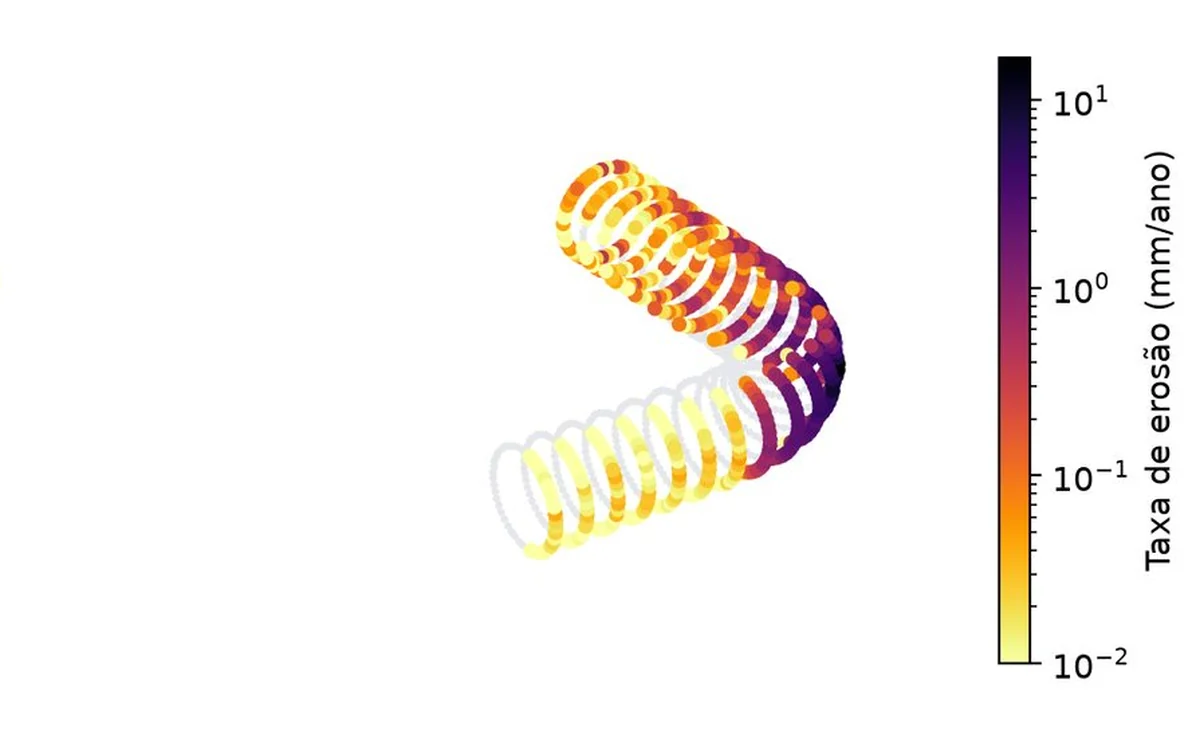
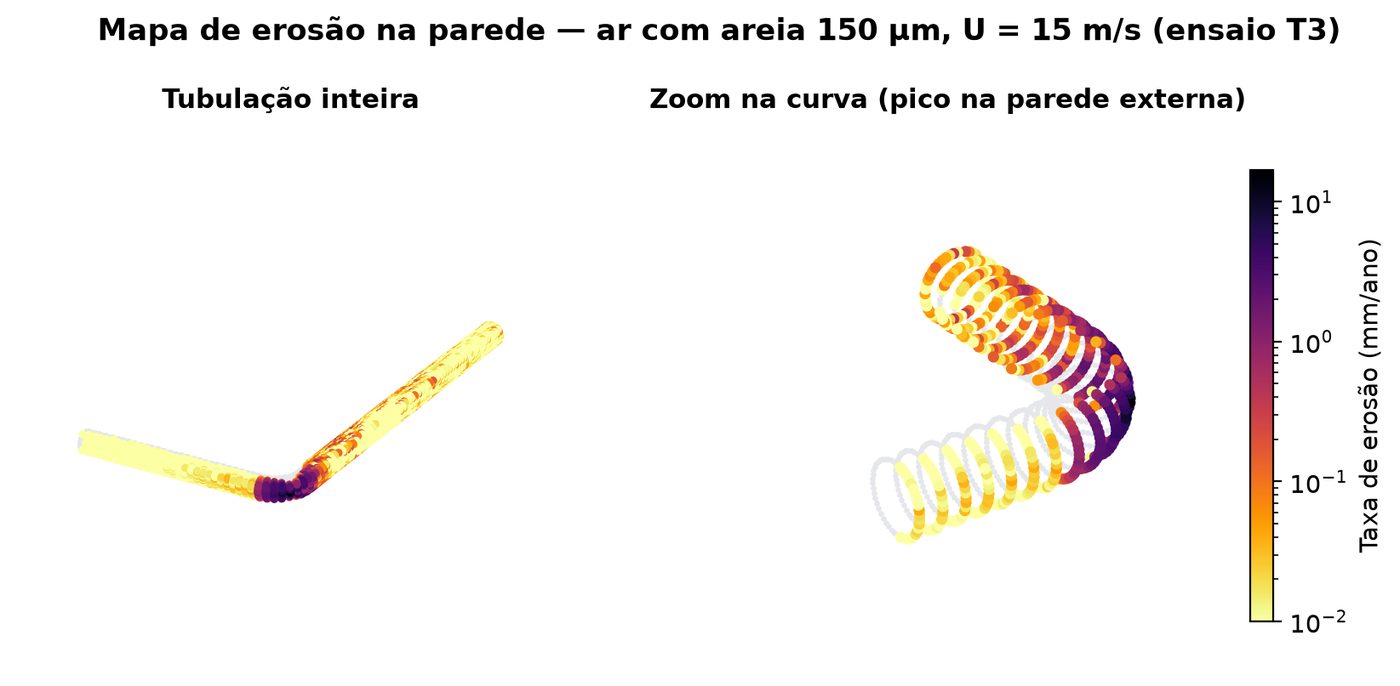
Erosion map from the open study: the whole pipe and the zoom into the bend, with the peak on the outer wall just after the bend entry. Scale in mm/year.
Three levels, three points: ΔP converges at 6.8–12.6% GCI on the fine mesh; erosion converges only at the reference point (2.9%). Where it does not, the report says so.
In the same study's proof map: 11 checks for, 0 against and 6 that did not run — 65% coverage, stated in the report.
Read the full study → Example report (PDF) ↗ Example reports →
Deadline and price
Studies run 4 to 10 weeks, depending on the scope. The quote is closed from the geometry, the fluid and the question — before any of the work.
We clarify the challenge, available data, constraints, and success metrics.
We combine simulation, AI, and engineering tools in a reproducible pipeline.
We document evidence, uncertainty, limits of use, and project results.
Other segments
Let's build your solution
Talk to our team about Physics AI consulting or explore PINNeAPPle Studio for modeling and verification workflows.