Erosion is not a phenomenon for 1% precision: it depends on the particle distribution, the material and the operating history. Practice accepts a factor of 2. The commitment on this project was to land inside that band, and to say so out loud, instead of promising precision the phenomenon does not have.
What was done
The full CFD pipeline: pipe geometry, mesh, OpenFOAM solving the particle-laden flow, a wall-erosion model, and a surrogate trained to answer quickly under new operating conditions.
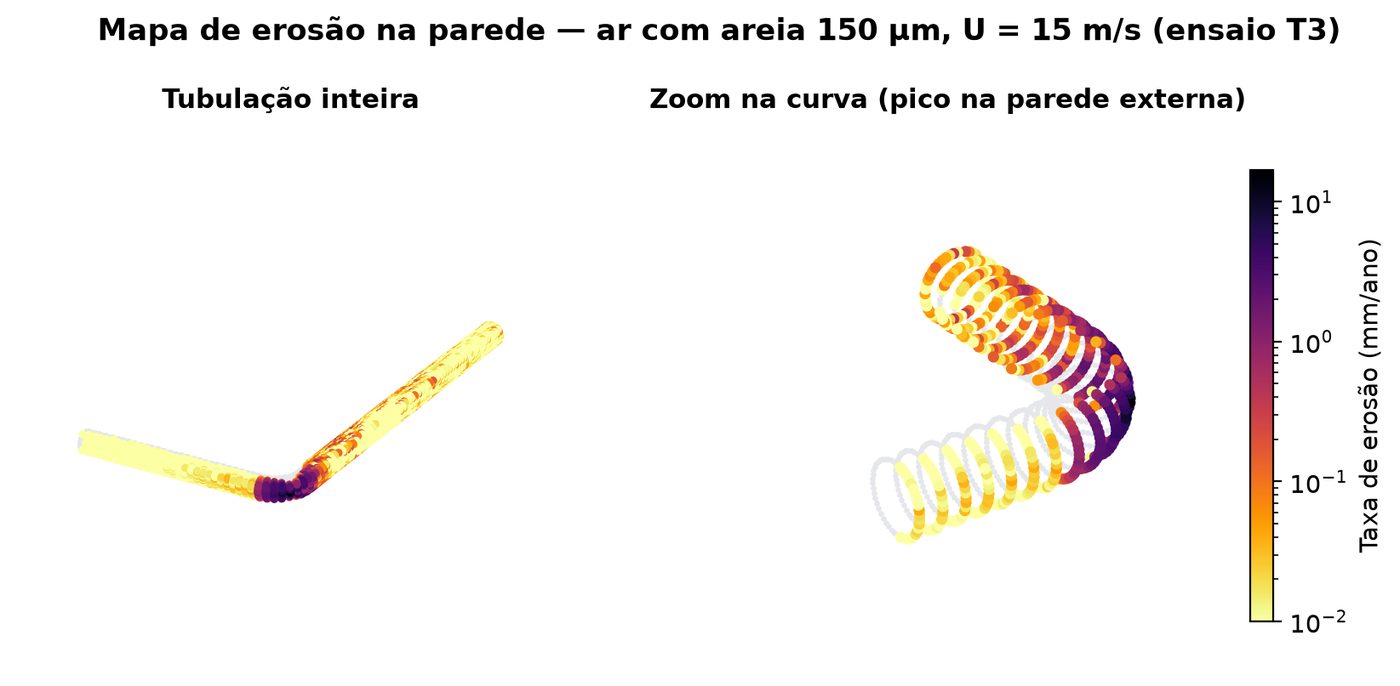
The numbers
1.05 to 1.49 times the rate measured in the Vieira et al. (2016) experiment. The surrogate came in at 1.0% error on pressure drop, at points it never saw in training. The study's 32 simulations, from geometry to trained model, took 23 minutes.
What it changes
With the surrogate, varying diameter, bend radius and flow rate no longer costs a day per point. CFD stays the reference; what changes is how many questions you can ask before paying for the expensive case.