Seven heat-sink geometries, a 3D solver and a model that returns junction temperature in milliseconds. 4.46% mean error; 7.35% worst case.
30 July 20266 min read
Anyone who designs heat sinks knows the routine: every change of fin is a new 3D simulation. Seven variants become a week; seventy become the whole project.
What was done
Seven heat-sink geometries solved in 3D FEniCS/dolfinx, with meshes built in gmsh. Then a surrogate trained on those simulations and compared against the solver at points that were not in the training set, the reference is always external to the model.
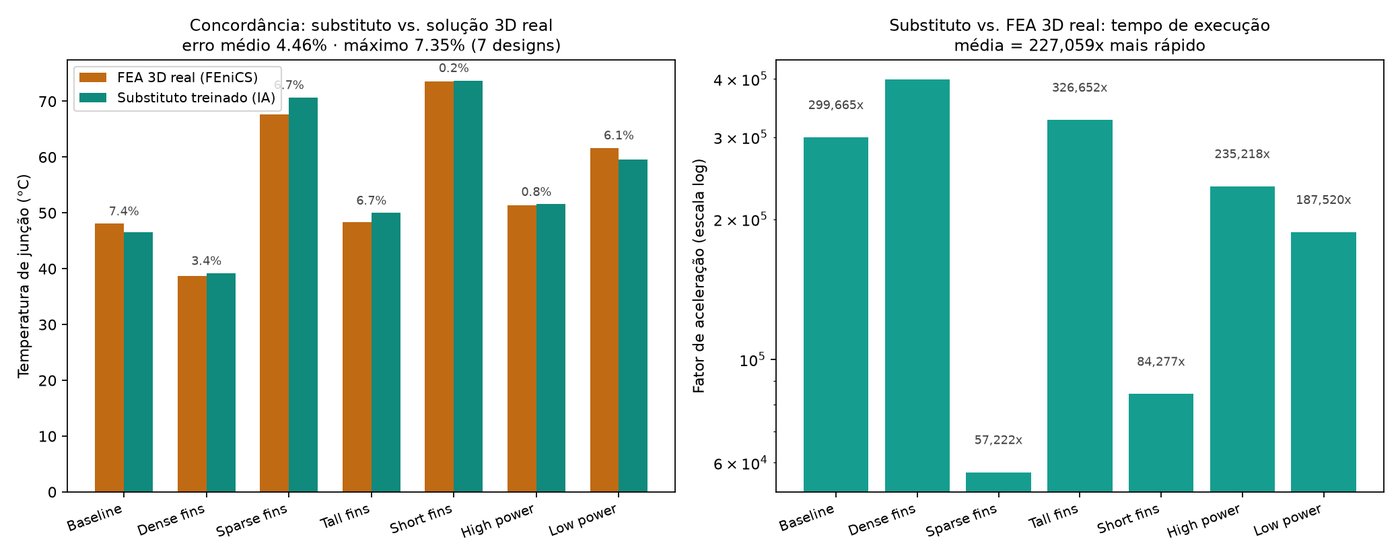
Left: junction temperature, surrogate against 3D FEA, mean error 4.46% and worst case 7.35%. Right: the time gained per geometry, a mean of 227,059×.
The numbers
Around 200,000 times faster (the measured mean across the seven geometries was 227,059×, with the worst case at 57,222×). Mean error of 4.46%, worst case 7.35%. And the prediction is deterministic: three runs, on different days, returned the same numbers.
The thermal sizing app running: the answer appears as you type
What it changes
Exploring the design space now fits inside one meeting. The solver is still called, to validate the choice, not to discover the optimum.
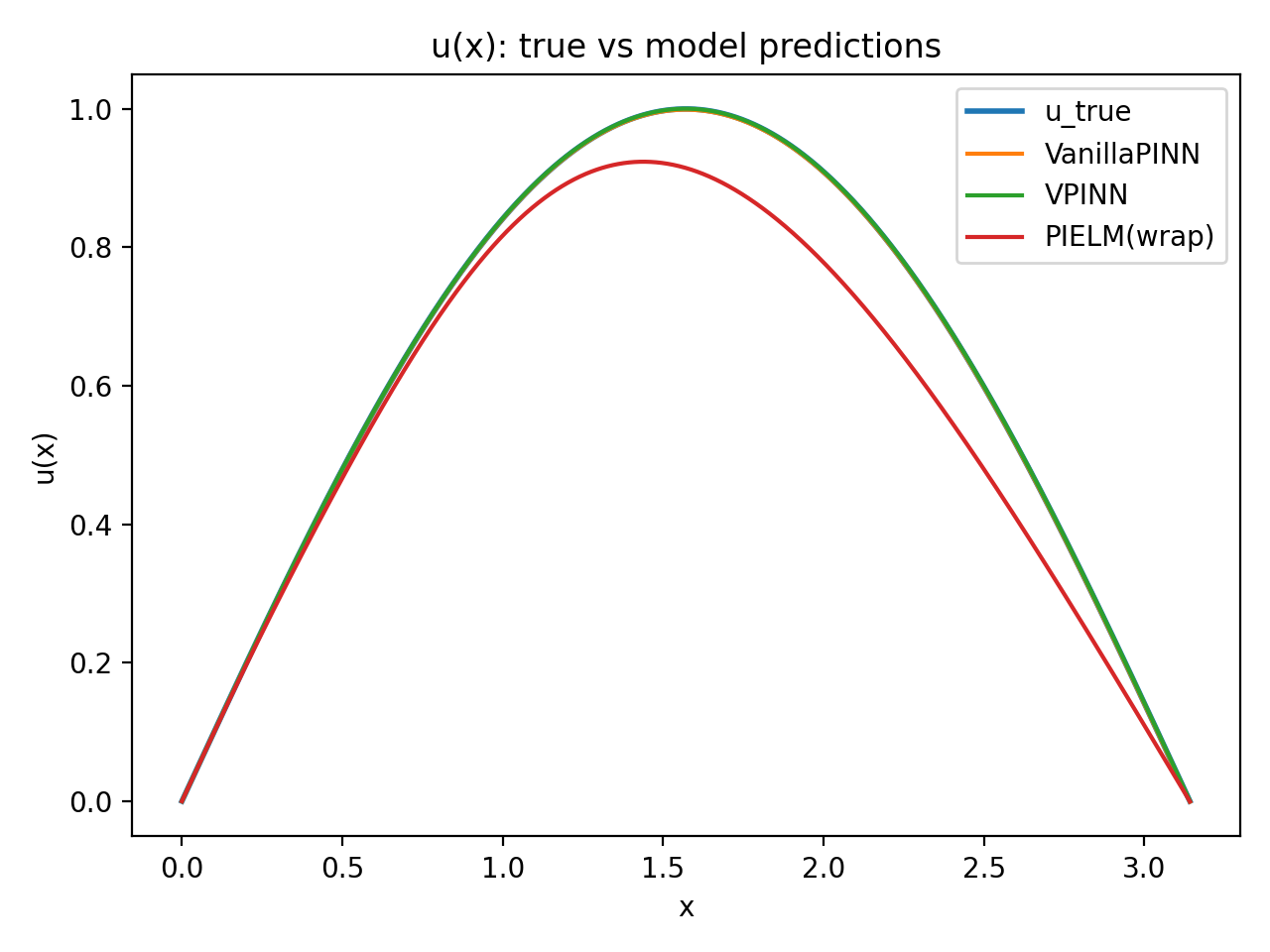
True against predicted: three models, the same boundary condition.
~200,000×faster, at 4.46% mean error
What was not proven: 4.46% is the mean inside the trained geometry range; outside it, the error is unmeasured. Determinism is not accuracy: the same numbers on every run say nothing about regions where there is no data.
Let's build your solution
Your engineering challenge could be our next project.
Talk to our team about Physics AI consulting or explore PINNeAPPle Studio for modeling and verification workflows.