A client arrived with an already-trained PINN model. The report showed what every report shows: a falling loss, a small error on the test points, a nice plot. The question was simple, and it is the one engineering always asks: can this be used in a design decision?
What the guardrail looks at
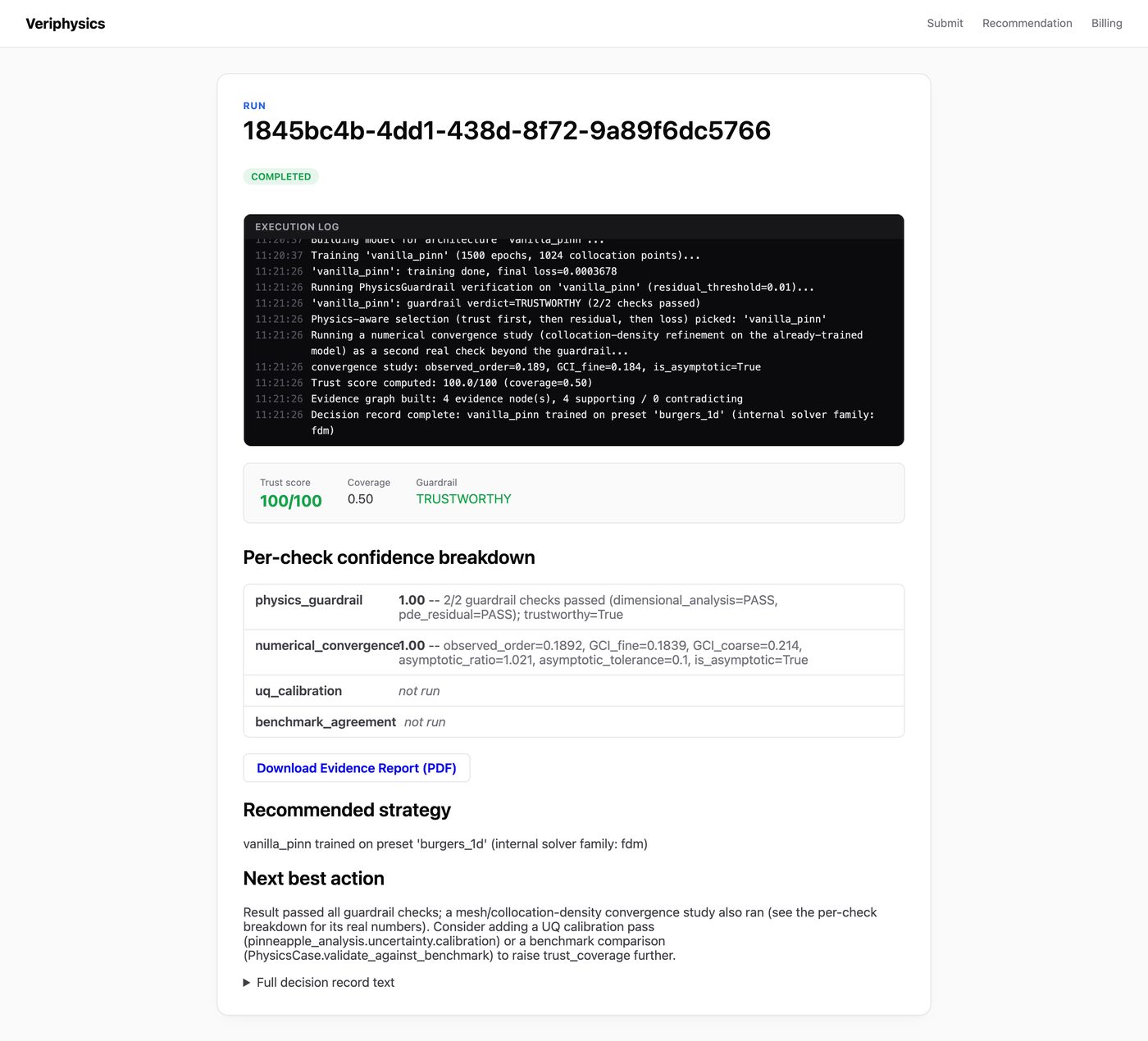
VeriPhysics does not look at the loss. It takes the trained model and measures what the loss does not: the residual of the equation the model is supposed to satisfy, the consistency of the boundary conditions, and the numerical convergence over the set of points where it was evaluated.
The number
The residual came out more than 100 times over the accepted threshold, with a training loss that looked healthy. The model matched the points in the history and violated the physics between them, which is exactly where nobody looks.
Around the same time, another case came up on the structural side: an unsupported beam that finished with the message “Job finished” and a displacement of 1.8×10¹¹ mm. The run finished; the result did not exist. Preflight flags FAIL before execution, naming the file and the line.
Why it became a product
A tool that only shows the good result pushes the decision onto trust. A tool that shows the check that did not run hands the decision back to engineering. The rule that stayed: a check that did not run never counts as passed, and the final score covers only what actually ran.