PINNeAPPle Request a quote

Optimization

1,920 wings, three objectives and 13% less CO₂

Multi-objective optimization in 3D CFD: every wing was flown in OpenFOAM, and the result is not “the best wing”, it is the map of trade-offs between three objectives that fight each other.

Making an aircraft more efficient is not about minimising one number. Less CO₂ per passenger usually comes with a slower cruise or a faster approach; slowing the approach usually costs drag. The design is a negotiation, and a negotiation needs a map, not a single answer.

What was done

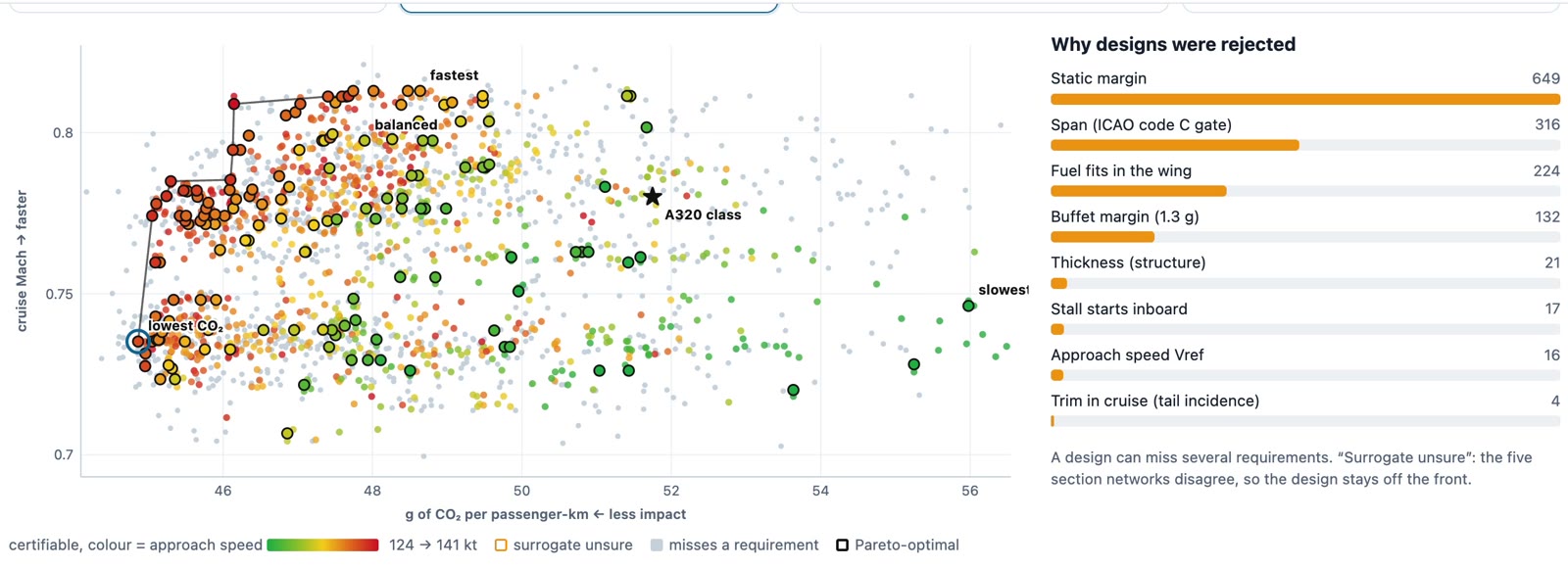
1,920 wing geometries generated and evaluated against three objectives at once: CO₂ per passenger-kilometre, cruise speed and approach speed. The evolutionary algorithm (NSGA-II) picks the next batch; a surrogate trained on the previous rounds guides the search; the candidates that survive are re-checked in 3D OpenFOAM before they enter the result.
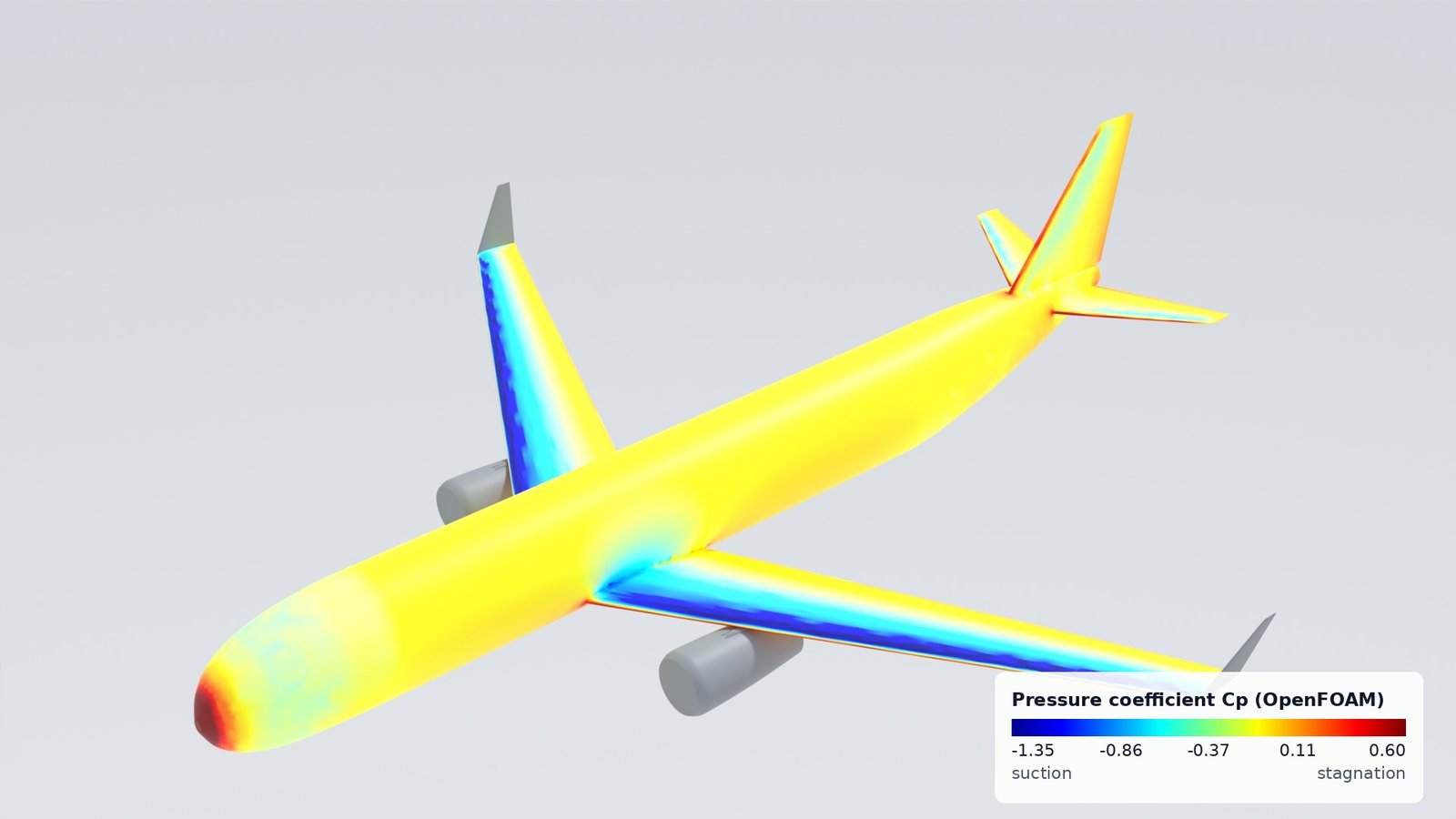
Skin pressure on one of the optimized wings
Skin pressure (Cp) in 3D OpenFOAM, one of the 1,920 designs evaluated.

The number

−13% CO₂ per passenger-kilometre across the solution set, with −18.2% profile drag and target lift held to within 0.04%.
Pareto front with three objectives
The Pareto front: no point dominates another across the three objectives. Every point is a trade, not a win.

How to read the result

The output is a set of wings, not one. Whoever wants less CO₂ accepts a different cruise; whoever needs a slow approach picks another point on the front. Optimization shows the price of each choice; engineering makes it.

The pressure field turning, from design to result
−13% CO₂/pax-kmwith target lift held to 0.04%
What was not proven: Optimization does not prove the wing is manufacturable, structurally sound, or good outside the simulated conditions. What is measured is drag, lift and CO₂ under the study's conditions, checked in the 3D solver.

Let's build your solution

Your engineering challenge could be our next project.

Talk to our team about Physics AI consulting or explore PINNeAPPle Studio for modeling and verification workflows.

Talk to an engineer