A neural operator can predict the peak displacement of a crash without running the crash. The exercise that prompted this text did exactly that on OpenRadioss data with a PhysicsNeMo Graph Neural Operator, and landed 3.5% on a held-out design. The question here is the same; what changes is where the data comes from — this library's own explicit crash solver, on a coupon that runs on a laptop.
The case
A DP1000 bumper beam held by two DP600 crash boxes, driven into a rigid pole: the component-scale half of a crash programme. Seven design variables — impact velocity (50 to 64 km/h), the two wall thicknesses, the two flow stresses, the pole radius and its lateral offset. The mesh is fixed, 2.783 nodes and 1.480 hexahedral elements, and 200 designs were solved by the explicit solver (J2 plasticity, penalty contact), 0.8 ms of the event in nine frames each.
What the network sees
Per node: the three coordinates, the part label (the beam and the two boxes) and the thickness. Per frame: the time. Per design: the seven variables, mapped to [0, 1] inside their own range and repeated on every node. That last part is what makes the model parametric. Since the mesh does not change between designs — which is what allows node-by-node comparison —, the geometry alone does not tell one design from another: without the design vector the network sees the same set of points 200 times.
The numbers
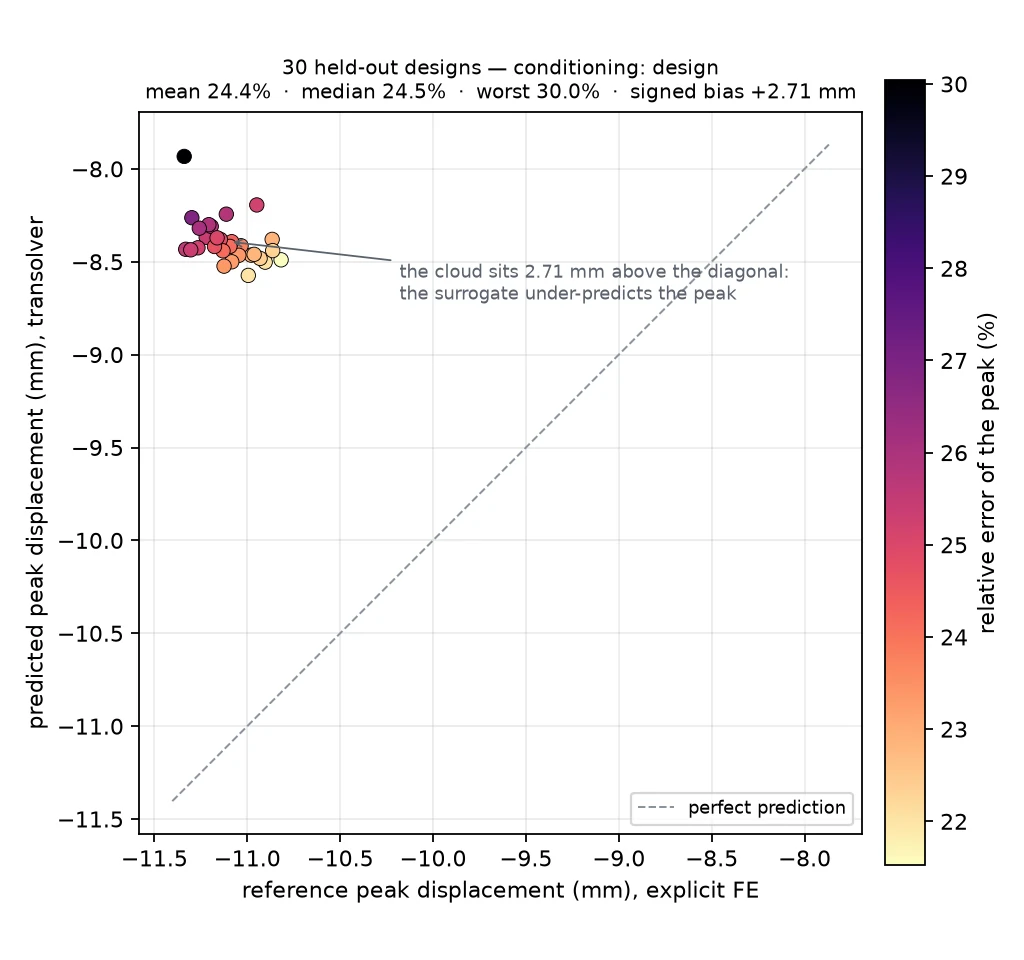
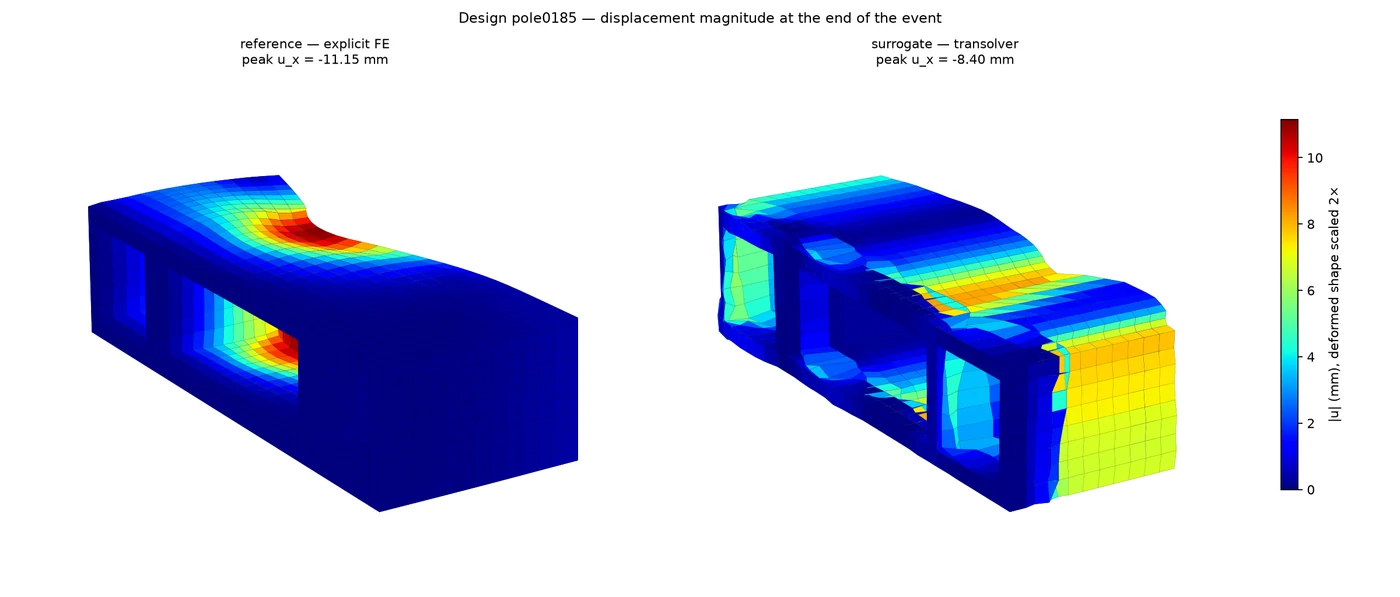
The relative L2 error of the displacement field, averaged over the 30 designs held out of training, is 0.28 (95% confidence interval: 0.27 to 0.29). The peak displacement — the smallest displacement along the impact direction, over every node and frame — comes out with 24.4% mean error, a median of 24.5% and a worst case of 30.0%. On design pole0185 the reference is -11.15 mm and the surrogate -8.40 mm. The error is not noise, it is bias: the cloud of points sits above the diagonal on all 30 designs — the model gets which design crushes more, and by how much, but under-predicts the magnitude of the peak by about 2.7 mm, which is what a smoothing regressor does.
Without the design vector there is no answer
The same Transolver, with the same training budget, the same split and the same node set, but without the seven variables, sits at 41.7% mean error on the peak (field error 0.76 against 0.28). It is not a worse model: it is a model without the information. It converges to the mean field of the training designs, because nothing it receives says which design is being asked about — and that is the difference between interpolating the corpus and answering for a new design.
What it costs
The solver takes about 3.7 minutes per design (measured: 223 s for 1.519 steps over 1 ms of the event, one process). The surrogate has 0.64 million parameters and infers a whole design in 197 ms, measured in the same benchmark. It is not 'a thousand times faster on a GPU': it is what lets a design space be swept before choosing which simulations to pay for.
What is not measured
The coupon is component scale and the mesh is coarse for a real crash; thickness enters through the flow stress on a fixed mesh, which under-represents bending; the error is against the solver itself, not against a test; and the peak is read on the 900 retained nodes, the same for every model — which does not change the ranking, but does change the number. Nothing here is certification: it is the protocol, with its limits next to it.
Why publish it
Because the useful result is not the surrogate's number, it is what it lets you decide: with the design vector inside the model a new design costs 197 ms instead of minutes of solver, and the error comes with an interval. The rest — including the run without the variables, which goes to 41.7% — is in the repository, in the same example that produced the figures.