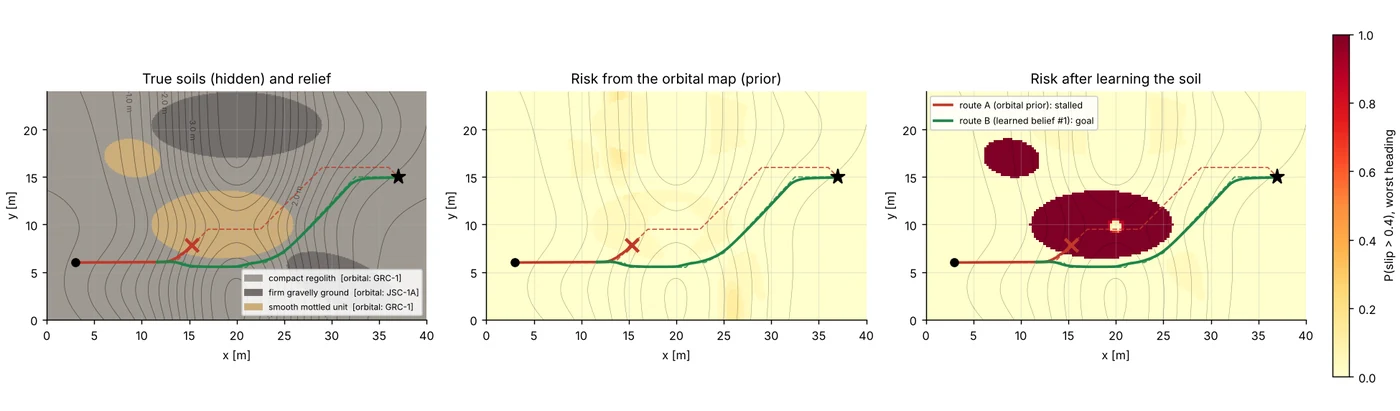
The mission, written in plain language, asks for a traverse to a sampling point. The direct plan, drawn from the orbital map, is 12.9 m long. It stalls a third of the way in, with 42% slip and 319 mm of sinkage: sand, not compact soil.
The loop
The platform runs the mission in the multibody simulator, sees the wheel spin, treats what it found as regolith, learns the soil parameters from the slip itself with an iterated Kalman filter, rebuilds the risk map and replans. None of that is handed in from outside: the only new signal is what happened at the wheels.
The numbers
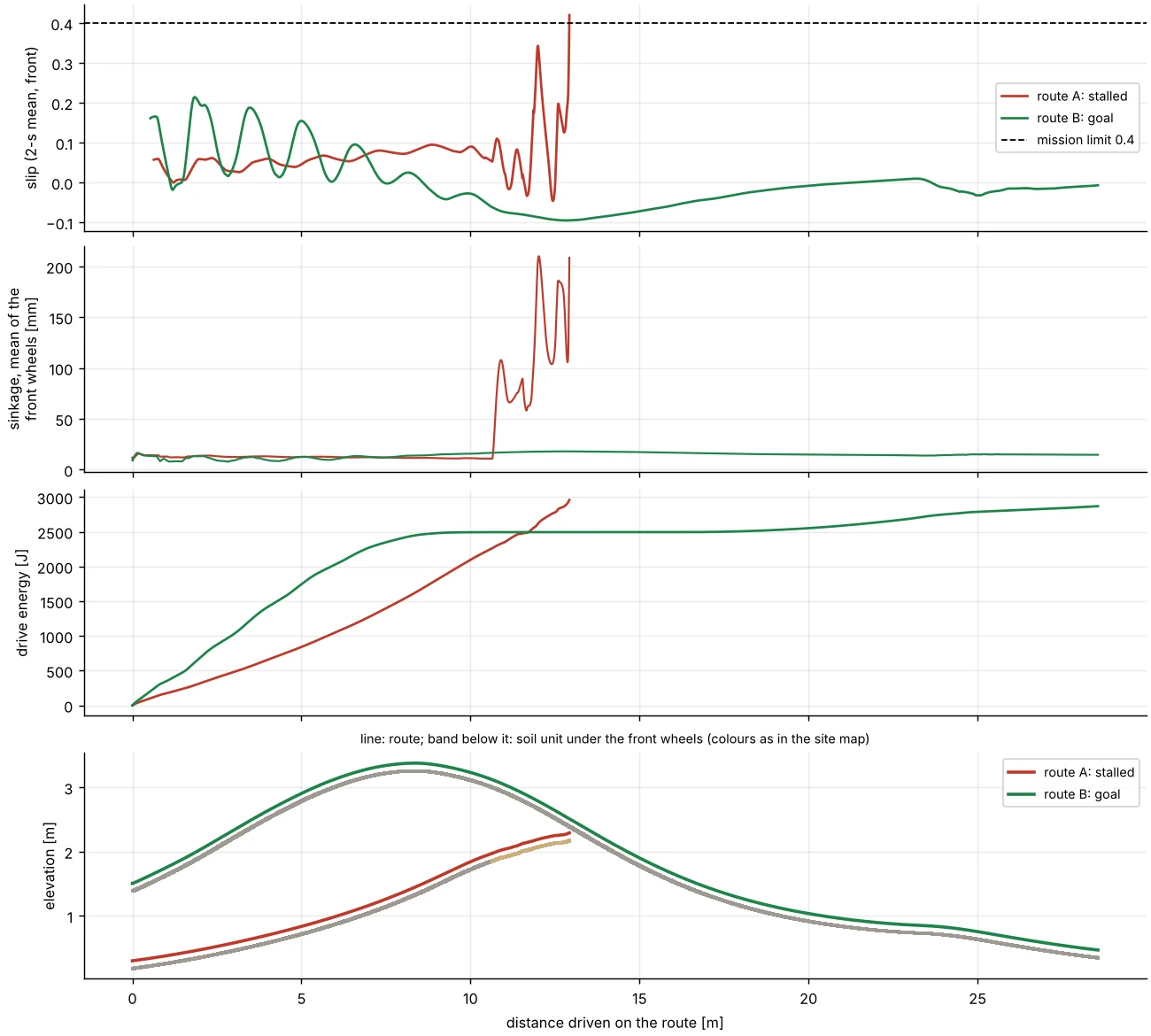
Route A, direct: 12.93 m, 2,958 J, maximum slip 0.42, maximum sinkage 319 mm, and the learned belief saying 100% of the route sat above the slip limit. Route B, replanned: 28.56 m, 2,869 J, slip 0.21, sinkage 30.7 mm and zero risk.
The longer route used 3% less energy. It covered 2.2 times the distance, with half the slip and a tenth of the sinkage, which is the point: in soft soil the cost is not the kilometre, it is the wheel spin.
What was learned, and with what error
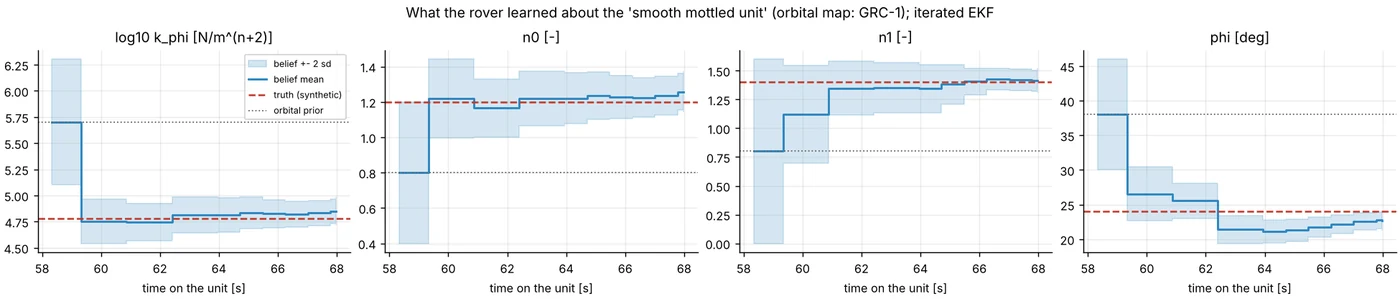
Against the true soil of the synthetic site, the final belief landed at 0.072 error in log₁₀ k_phi (1.14 posterior standard deviations), 0.057 in n0 (1.02) and 0.0145 in n1 (0.29). The error is small and, more importantly, consistent with the uncertainty the filter itself declares.
Why this is the product
The difference between a plan and a good plan is what gets learned on the way. Here the way teaches, the plan changes, and the report states what was learned and with what error, which is what lets an engineer accept or refuse the decision.