
Success stories · Case · power electronics
A trained surrogate answers 227,000 times faster than the 3D simulation
Seven real heat sinks, every prediction checked against a real finite-element simulation — never against another AI model.
Validated
Objective
Optimising a heat-sink geometry means running dozens of 3D thermal simulations, each taking seconds. That rules out an interactive design sweep or an optimiser that has to evaluate hundreds of candidates. A surrogate that answers in microseconds solves the cost — provided every prediction it makes is checked against a real simulation, and not against the model that trained it.
Key results
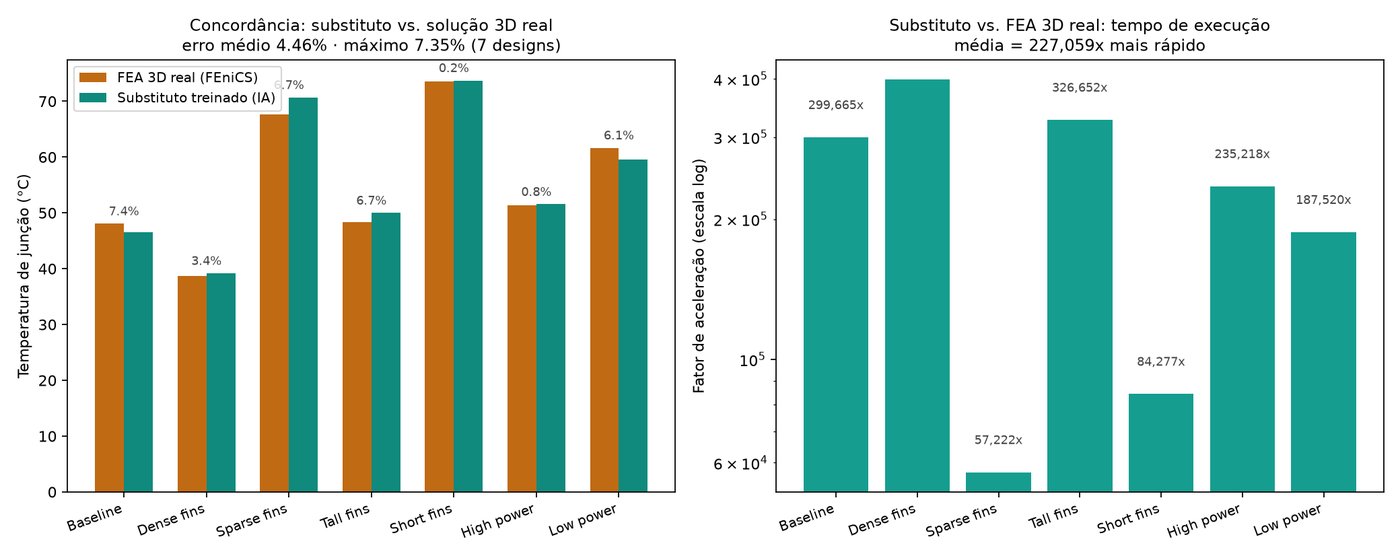
- Across seven significantly different geometries — dense, sparse, tall and short fins, at high and low power — the surrogate answered in microseconds where the real simulation took 0.6 to 5.9 seconds.
- Temperature error stayed inside 10% in every case: 4.46% mean, 7.35% worst case.
- The error is reproducible. Three runs on different days gave exactly the same temperature error; only the speed-up factor moves, because it depends on machine load at test time.
Seven geometries, seven real 3D simulations
The test set was built to contain the changes that break surrogates trained on small variations: fin density, height, base thickness and power level all move together across the seven designs.
Every point in the figure below is a surrogate prediction measured against a finite-element solution solved on the spot — not against a stored training result.
Why the reference is FEA, not the model itself
A surrogate validated against its own training validation set only measures how consistent it is with itself. That is why the 0.01% errors in many surrogate reports do not survive the first new geometry.
Here the reference is external and independent: a finite-element solver, with a mesh built by gmsh, solved for each of the seven designs at test time.
What the speed-up factor measures — and what it does not
Speed-up is a ratio between two wall-clock times, and the reference simulation time depends on the machine. That is why the factor ranges from 57,000× to 399,000× across designs and runs, while the temperature error is identical across all three.
The correct reading is: the prediction is deterministic, the reference cost is not.
“The temperature prediction is deterministic — the same error across three runs. Only the speed-up factor moves with machine load at test time.”
Let's build your solution
Your engineering challenge could be our next project.
Talk to our team about Physics AI consulting or explore PINNeAPPle Studio for modeling and verification workflows.