Physics Anomaly Detector (day 28)
Which balance broke, by how much, and which sensors are involved. Live at https://anomaly.pinneapple.org.
Source: apps/anomaly_detector.
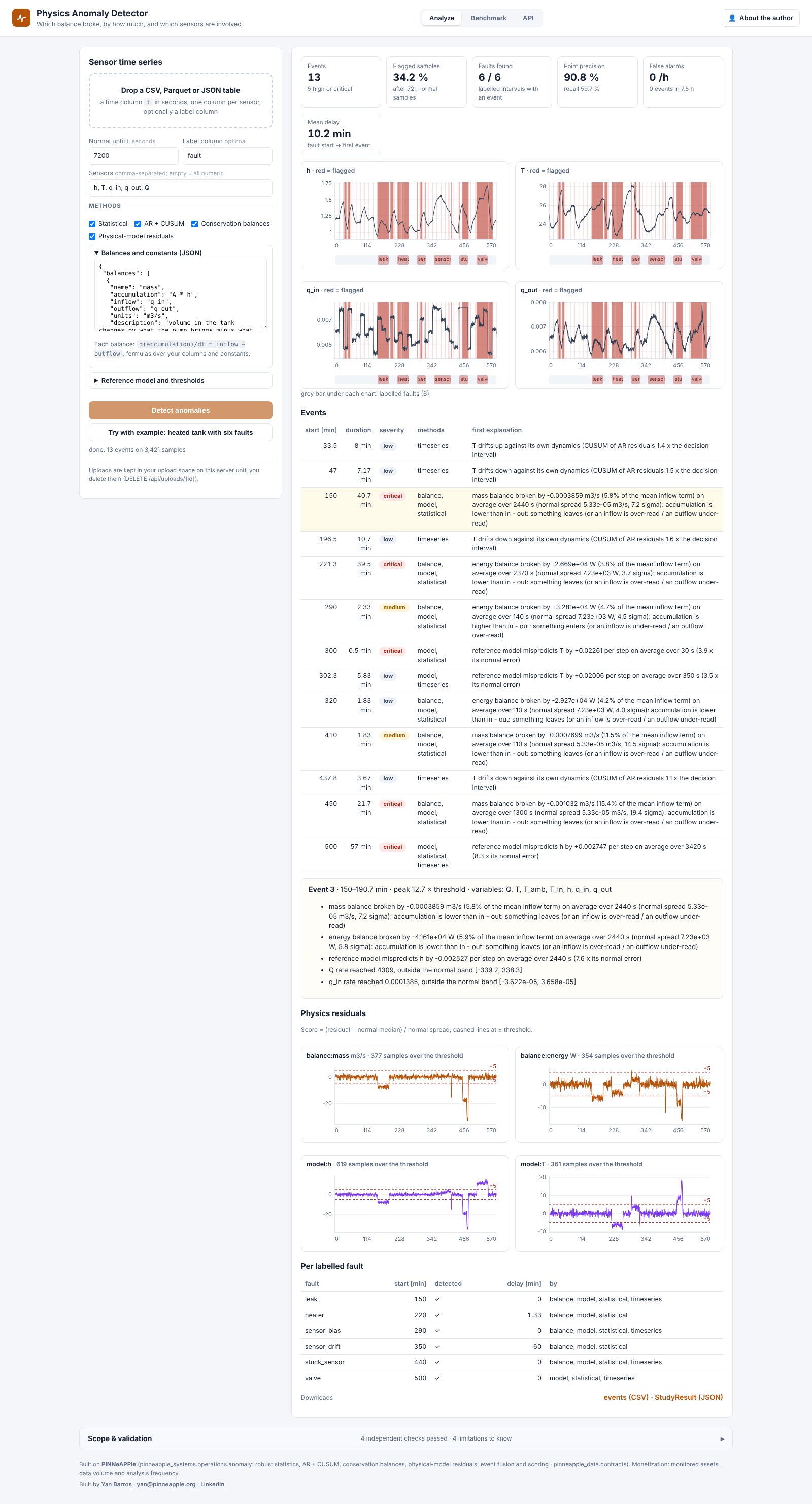
Upload sensor time series and the end of a window you know is normal. Add conservation balances written as formulas over your columns, and optionally a physical reference model. Four detector families run, each calibrated only on the normal window:
| Family | What it sees |
|---|---|
| Statistical | values and rates outside their normal band (robust z-score) |
| AR + CUSUM | slow drifts against a signal's own dynamics |
| Conservation balances | d(accumulation)/dt = inflow − outflow broken, with the size and direction in the law's units |
| Model residuals | a reference model that mispredicts a state from the measured inputs |
Flags become events with a severity, the variables involved and explanations. With a label column, the app computes precision, recall, false alarms per hour and detection delays.
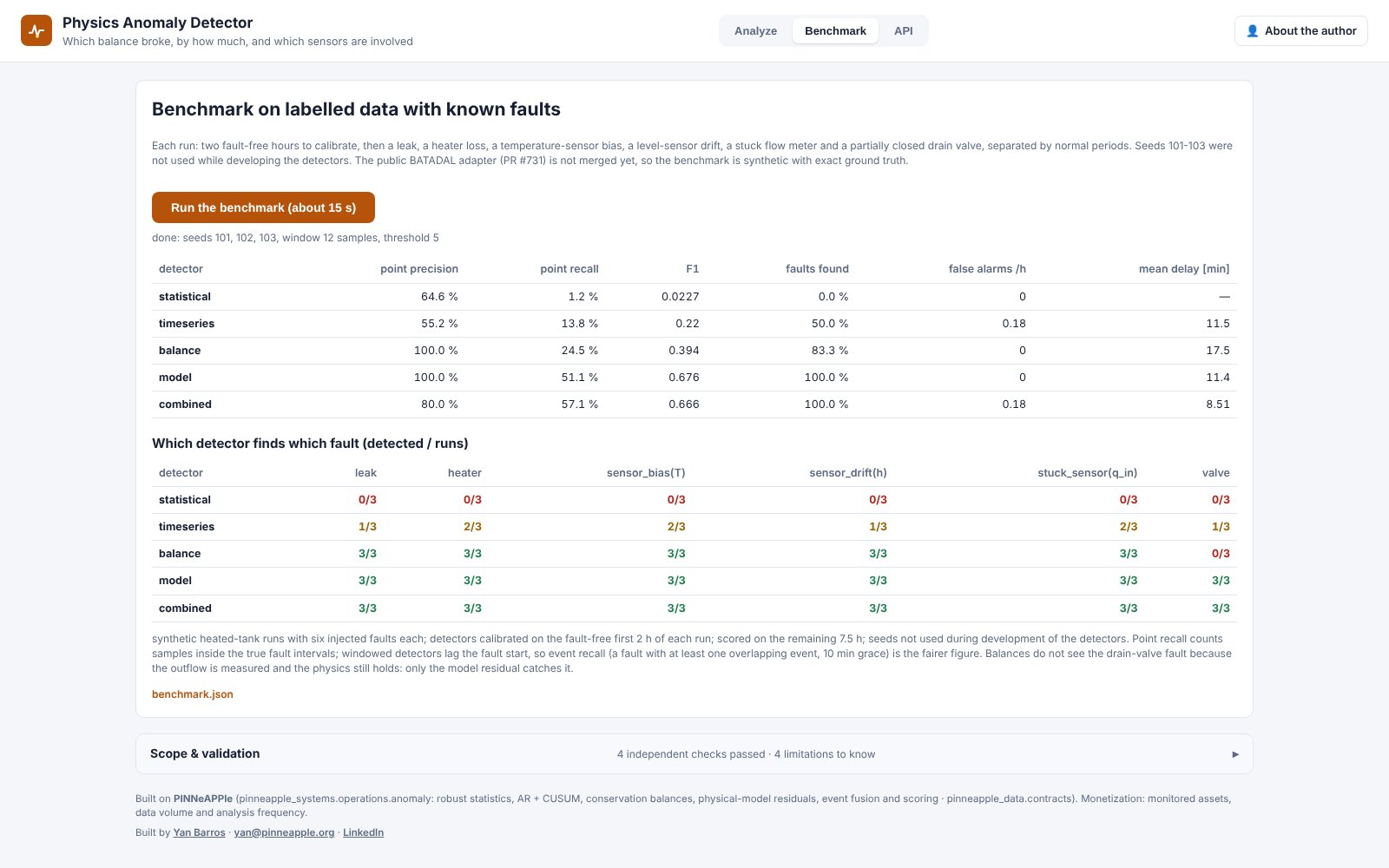
Benchmark
The benchmark uses labelled synthetic runs of the heated tank: a leak, a heater loss, a sensor bias, a sensor drift, a stuck meter and a valve fault, on seeds not used during development. The combined detector finds every fault with 80 % point precision and 0.18 false alarms per hour. The balances alone never false-alarm but miss the valve fault, because the outflow is measured and the physics holds. The public BATADAL adapter (PR #731) is not merged yet.
Automate it
POST /api/analyze with an upload_id, normal_until, balances and constants returns a job. The events and
scores are in GET /api/jobs/{id}; the downloads are events.csv and anomaly.study.json. In Python, call
pinneapple_systems.operations.anomaly.detect.
Limits
- "Normal" is whatever the declared window contains.
- A broken balance does not say whether the plant or a meter is at fault.
- The benchmark is synthetic until a public labelled set lands.
Monetization: monitored assets, data volume and analysis frequency.