Simulation Workflow Runner: campaigns as traceable, resumable workflows
The Workflow Runner (day 27, runner.pinneapple.org) runs a simulation campaign as a DAG of steps per case. It records what happened to every step, picks up where an interrupted campaign stopped, reuses steps whose inputs did not change, and returns the finished runs as a training dataset. It orchestrates the tools you already have (OpenFOAM, CalculiX, Python, Docker, Slurm); it does not replace them.
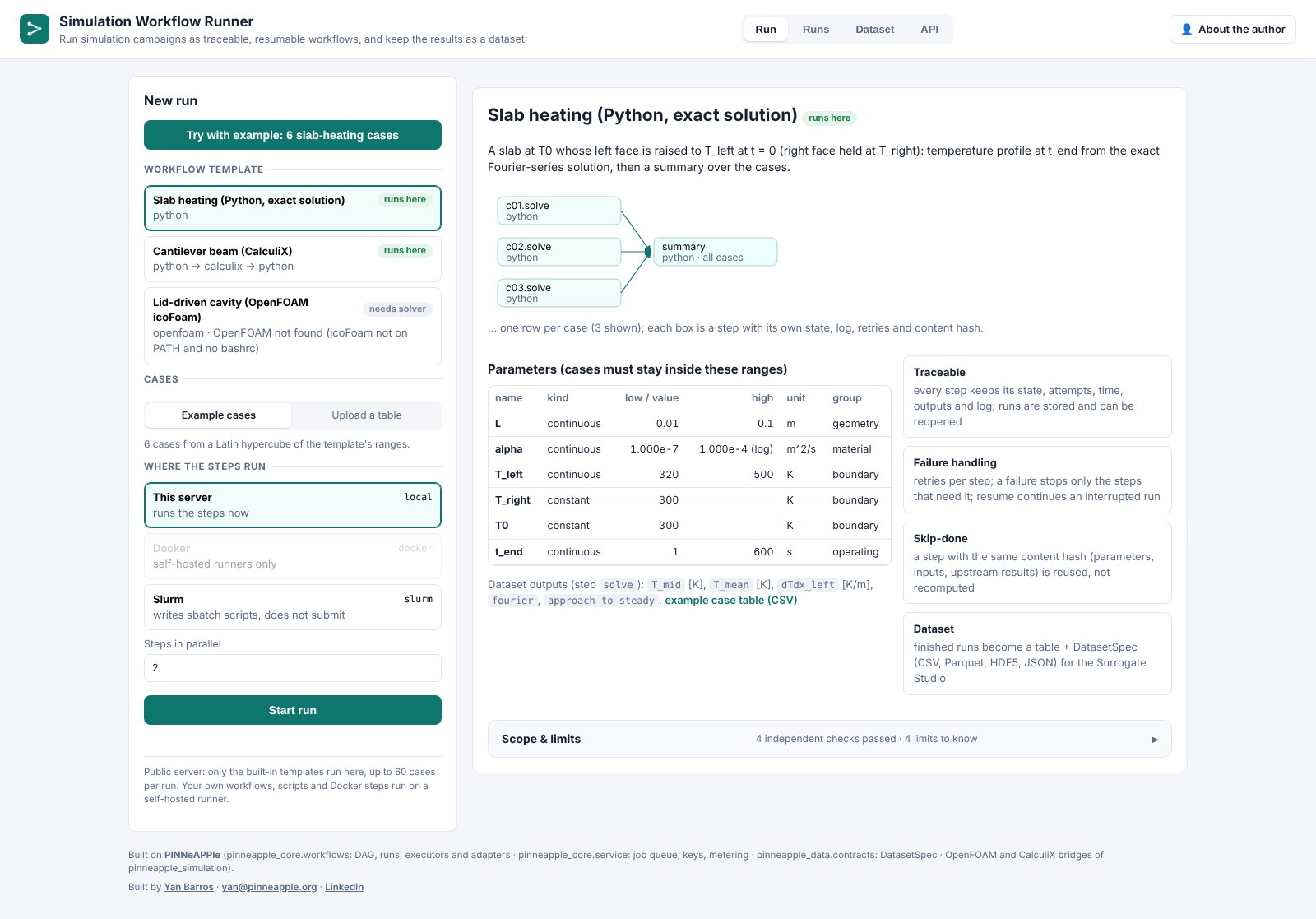
From cases to a dataset
- Cases. A table with one row per case, as CSV, Parquet, HDF5 or JSON. A Campaign Planner export works as it is,
including its
.contract.jsonsidecar. On the public server the columns must be the template's parameters, inside its ranges. - Template. The steps run for each case and their dependencies:
- slab heating: the exact solution of transient conduction, in Python;
- cantilever beam: a CalculiX deck from
calculix.study.FEModel, thenccx, then a comparison with beam theory; - lid-driven cavity: OpenFOAM's icoFoam on the tutorial case with edited dictionaries.
- Executor. Where the commands run: this server, Docker (self-hosted), or Slurm. On the public server, the Slurm executor only writes the sbatch scripts.
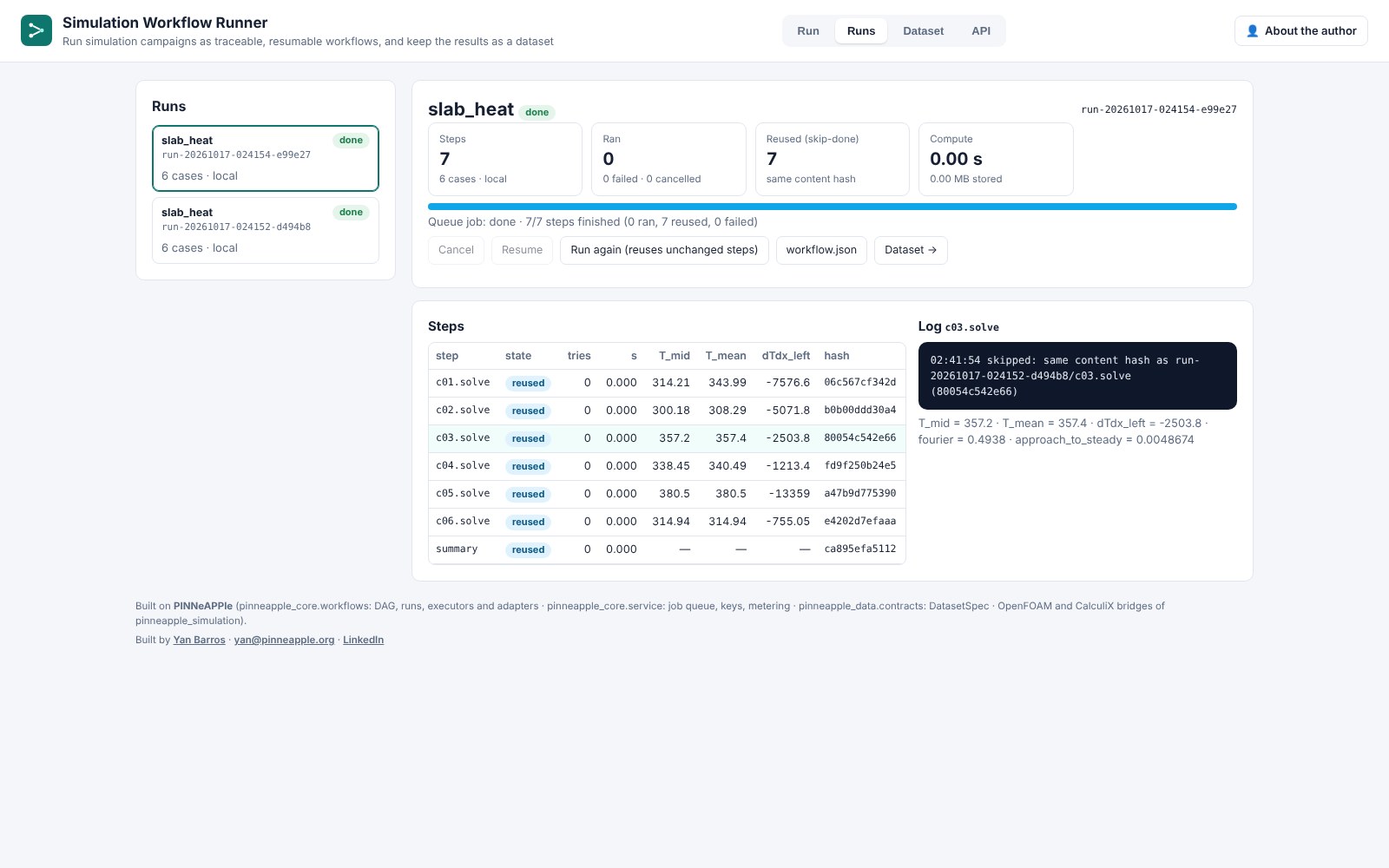
- Run. Each step has a state, attempts, wall time, outputs and a log. A failed step cancels only the steps that need it. Resume continues an interrupted or failed run. Run again starts a new run and reuses every step whose content hash is unchanged.
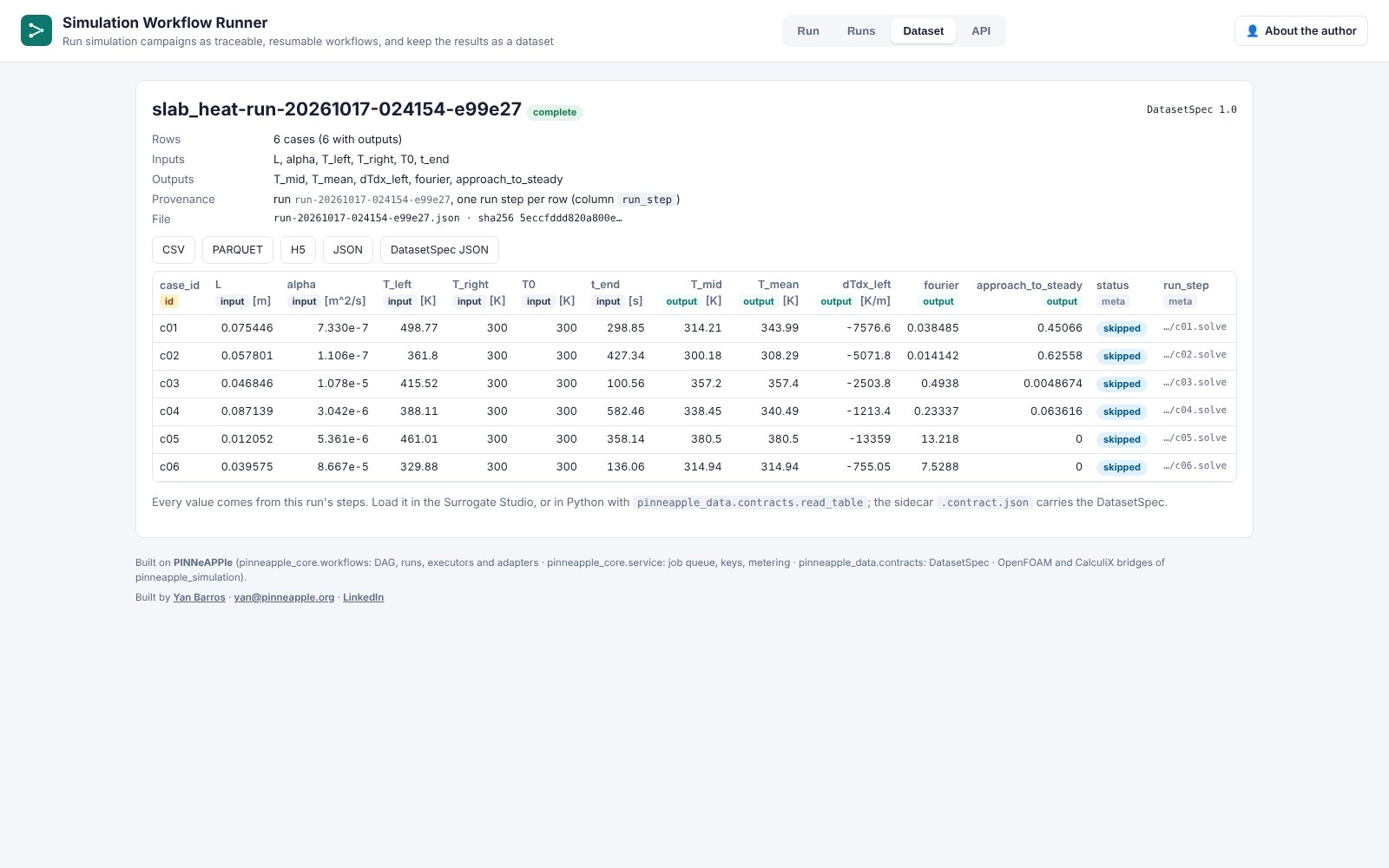
- Dataset. The parameters and outputs of every case, as CSV, Parquet, HDF5 or JSON, with a
DatasetSpec. The spec records columns with units and roles, the file's SHA-256, and the run step behind each row.
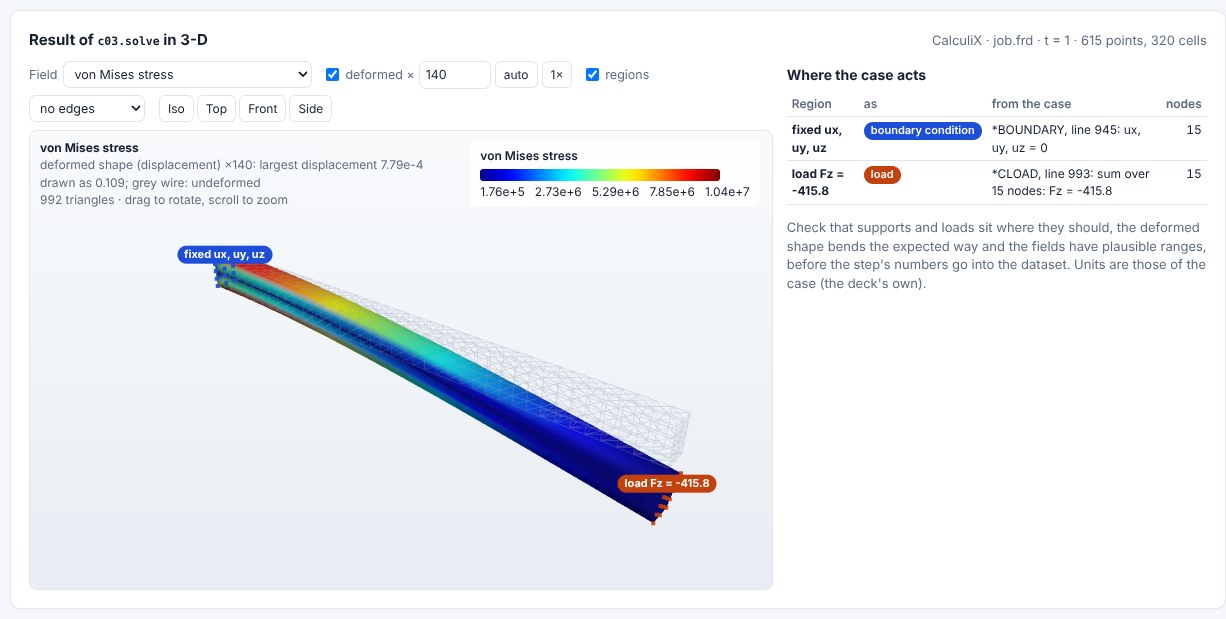
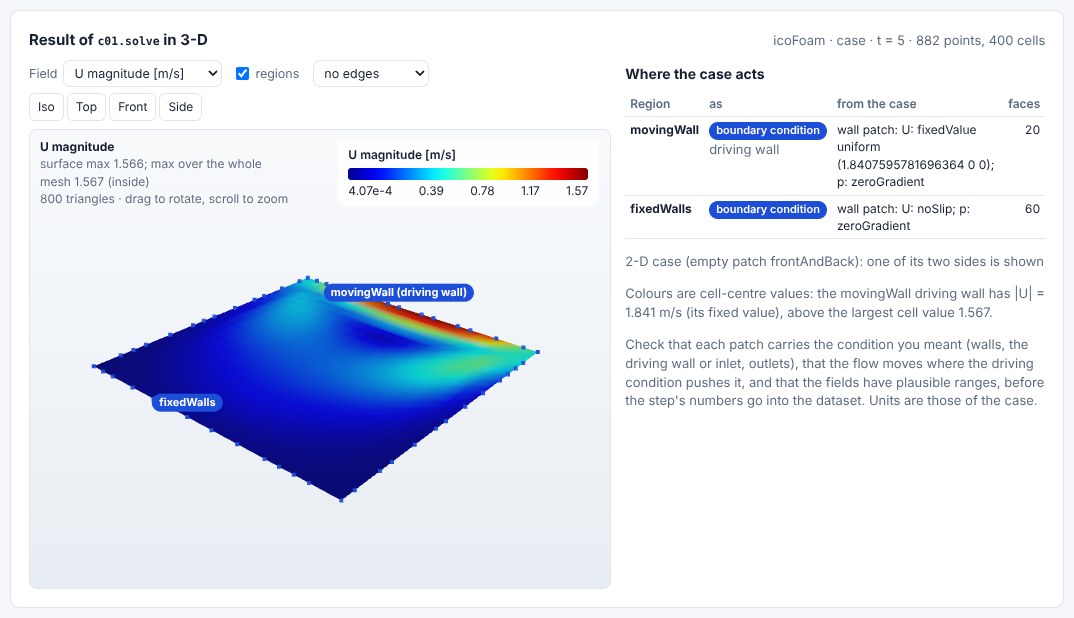
View a solver step's result in 3-D
A finished CalculiX or OpenFOAM step has a View result in 3-D button, a check before its numbers are used. It shows the mesh, the selected field and, for CalculiX, the deformed shape with a scale factor. The regions where the case defines its boundary conditions and loads are marked:
- CalculiX: the
*BOUNDARY,*CLOADand*DLOADsets of the deck; - OpenFOAM: the patches, with their conditions from the first time directory.
Large meshes are decimated above 250 k triangles (RUNNER_VIEW_MAX_FACES, from the size guide in
the studio page). In Python:
pinneapple_tools.visualization.studio.solver_view.solver_result_view(step_folder).
The same engine in Python
from pinneapple_core.workflows import Step, Workflow, WorkflowRunner, TEMPLATES, dataset_from_run

runner = WorkflowRunner("work/runner")
t = TEMPLATES["slab_heat"]
cases = t.example_cases(20)                       # or read_cases("campaign.parquet")
run = runner.run(t.workflow(cases, max_parallel=4))
runner.run(run_id=run["id"])                      # resume (no-op when everything finished)
spec, path = dataset_from_run(runner, run["id"], cases, output_step="solve", path="slab.parquet")

wf = Workflow("beam", [
    Step("mesh", "command", {"argv": ["gmsh", "-3", "beam.geo", "-o", "beam.inp"]}, inputs=["beam.geo"]),
    Step("solve", "calculix", {"inp_from": "mesh", "job": "beam"}, needs=["mesh"], retries=1,
         executor="slurm", executor_options={"partition": "cpu", "ntasks": 8, "dry_run": True}),
])
New step kinds and executors plug in with register_adapter and register_executor (see
the app README).
This is how the Engineering GUI Agent adds GUI-driven steps.
What was checked
- Skip-done, resume, retries. Tests in
tests/pinneapple_core/test_workflows.pycover: - a rerun with unchanged content runs nothing;
- changing one step's parameter reruns it and everything downstream;
- a crash mid-run is resumed without redoing finished steps;
- retries recover from transient failures;
- cancel kills a running command.
- Slurm. The generated script carries the partition, tasks, memory, account, time limit, modules and the
srunline (dry run, tested). - CalculiX template. With CalculiX 2.21, the C3D8I tip deflection is 0.993 to 1.007 of Euler-Bernoulli over the
six example beams. The test asserts within 2 % whenever
ccxis installed.
Limits
- Public server: built-in templates only, with numeric case values checked against the template's ranges.
Self-hosting (
RUNNER_SELF_HOSTED=1) enables custom commands, scripts and Docker steps. Only do that behind your own login. - Solvers. The public image has no OpenFOAM or CalculiX. Those templates show "needs solver" there instead of pretending.
- OpenFOAM environment. OpenFOAM steps source the step's
bashrc, elseFOAM_BASHRC, else the first installation found in/usr/share/openfoam,/usr/lib/openfoam/openfoam*,/opt/openfoam*or/opt/OpenFOAM-*, unless the environment is loaded already (WM_PROJECT_DIRset). - Skip-done hashes only what a step declares. Undeclared input files and solver versions are not seen.