Engineering Design Optimizer (app, day 17)
Black-box design optimisation within physical and manufacturing limits, with the chosen candidates confirmed by a
high-fidelity model. Live at https://optimize.pinneapple.org; source and deployment notes in
apps/engineering_optimizer.
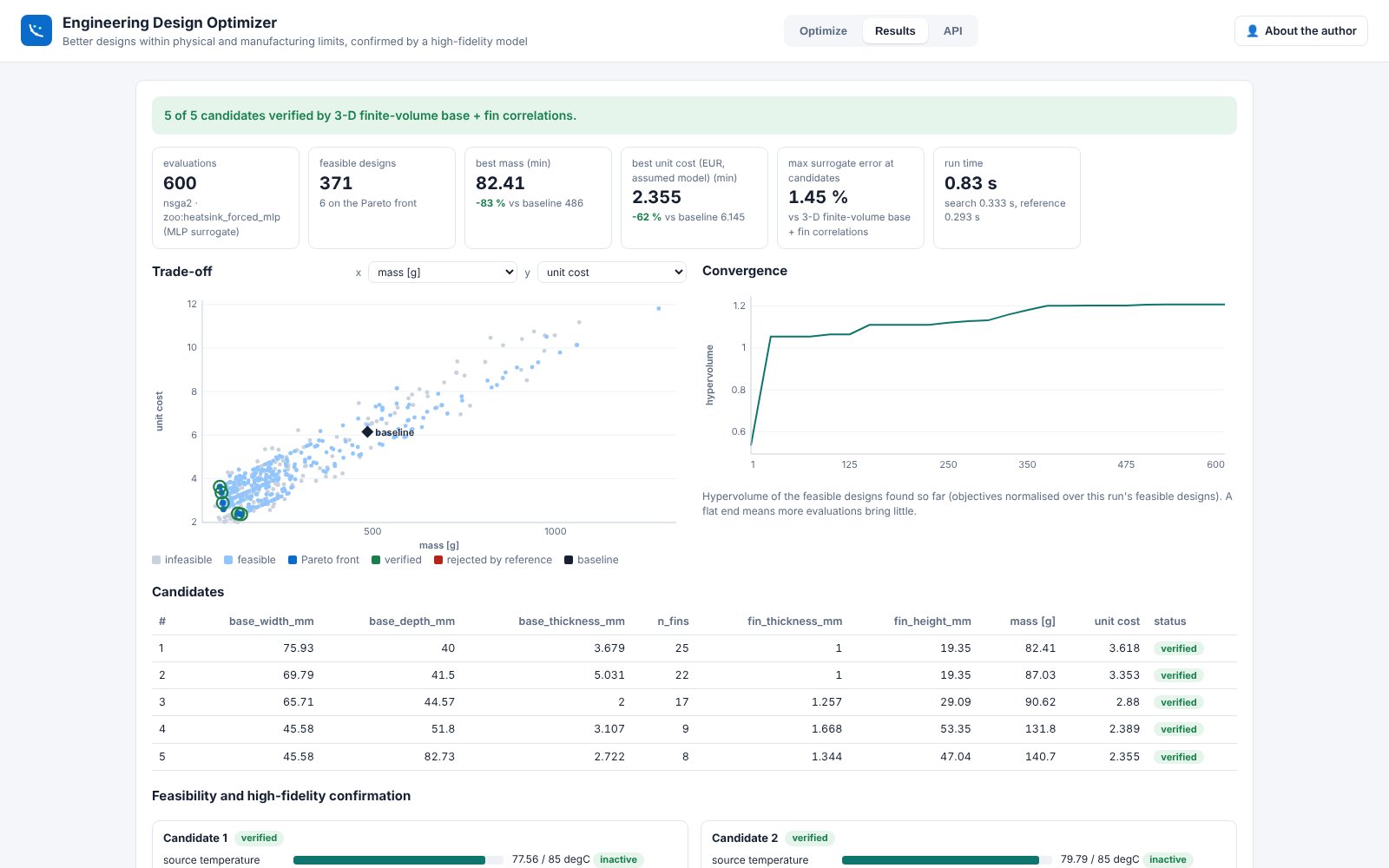
| Input | design variables (or a ParameterSpace), objectives, constraints, and an evaluation model: the heat-sink example (zoo surrogate or closed form), a table of designs you evaluated (GP surrogate with held-out error), a pp.zoo model (ModelRef URI zoo:<name>), or an operator-configured solver |
| Methods | NSGA-II (library and pymoo), SciPy differential evolution, Bayesian optimisation, Latin-hypercube baseline; optional active learning against the reference |
| Output | candidates along the Pareto front with a verification status, trade-off and convergence plots, feasibility report (active constraints, margins), surrogate vs reference errors, CSV / ParameterSpace / ModelRef / StudyResult files |
The engine is the library: Design studies. The same problem through Python:
from pinneapple_design.design_optimizer import problem_from_spec, reference_for_spec, run, verify_candidates
from pinneapple_design.design_optimizer import select_candidates

spec = {"source": "preset", "preset": "heatsink", "objectives": [{"name": "mass_g"}, {"name": "cost"}]}
problem, _ = problem_from_spec(spec)
res = run(problem, "nsga2", budget=600)
report = verify_candidates(problem, res.evaluations, select_candidates(res.evaluations, res.pareto(), 5),
                           reference_for_spec(spec))
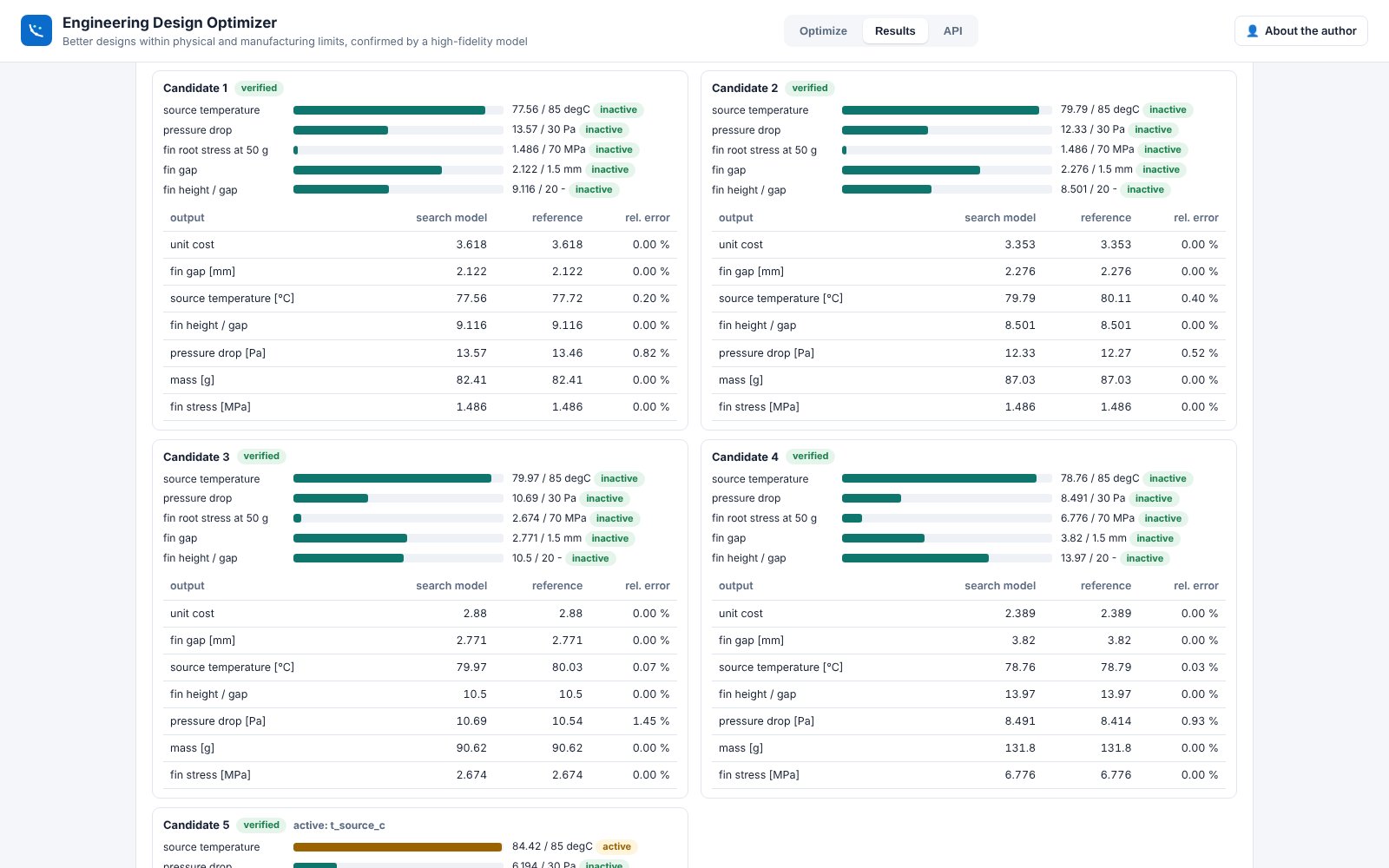
Limits. Candidates are optimal for the search model; only those the reference re-evaluated are "verified". The heat-sink example assumes ducted laminar flow and no radiation, and its cost model is a placeholder for your numbers. A surrogate from your data is valid inside the range of the data only.