Molecular visualisation: proteins on metal surfaces
pinneapple_tools.visualization.molecular (also pp.molecular) shows molecules alone or adsorbed on metal surfaces.
It covers the visual side of a protein-on-metal molecular dynamics (MD) pipeline, such as RoyalMD Gold
(TheVisualHub/RoyalMD_Gold) runs with OpenMM. It contains no MD engine: anything that gives atom positions can be
shown, such as a PDB file, an OpenMM or mdtraj trajectory, or the torch MD of pinneapple_simulation.
| Function | What it does |
|---|---|
Molecule.from_pdb, Molecule.from_mdtraj |
Read atoms, elements, residues and chains; multi-MODEL PDB files give the frames. Also provide the CA backbone trace and the residue class (hydrophobic, polar, positive, negative, special) |
fcc_slab(metal, facet, nx, ny, layers) |
fcc slab of Au, Ag, Cu, Pt, Pd, Ni, Al or Pb, with a (111), (100) or (110) top facet, in whole lattice repeats so a periodic box does not strain it |
slab_for_footprint(xyz, ...) |
Size the slab from a molecule's footprint plus padding, centred under the molecule |
orient_on_surface(xyz, masses, active_site, gap) |
Turn the thinnest principal direction toward the surface normal (broadest face down), turn the active site away from the surface, place the lowest atom gap Å above it |
render(...) |
Off-screen still with pyvista: space-filling or backbone tube, coloured by residue class, element, chain or height, on a metallic slab with three-point lighting |
render_frames(...) + encode_mp4(...) |
Trajectory as PNG frames (fixed camera or slow orbit, time labels) and an H.264 MP4 (imageio-ffmpeg) |
md_dashboard(...) |
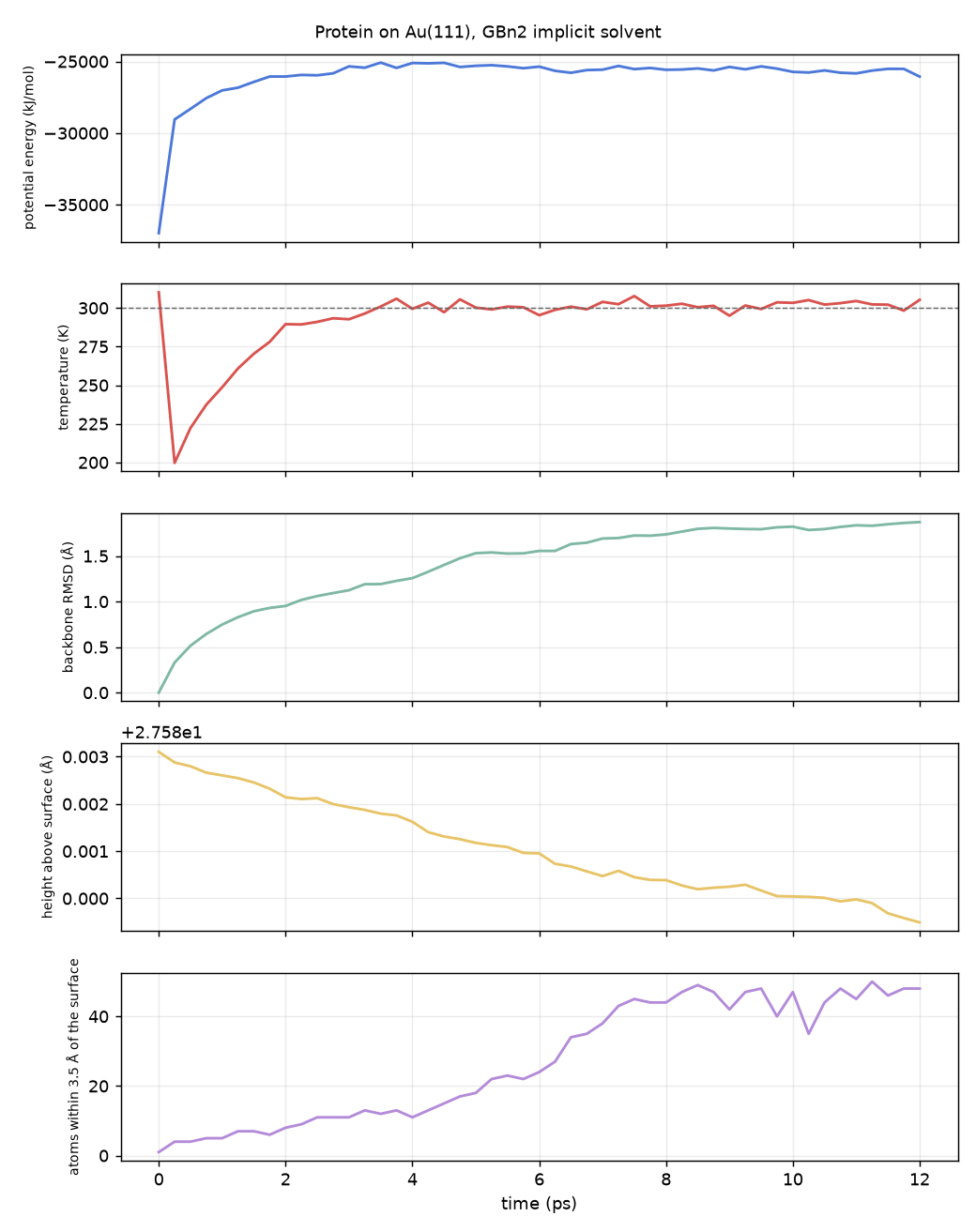
Potential energy, temperature, backbone RMSD, height above the surface and contacts over time |
rmsd, height_above, contacts |
The analysis behind the dashboard |
to_glb(...) |
glTF scene (one mesh per residue class and the metal), for the PINNeAPPle web viewer or any glTF viewer |
StepLog |
Numbered, optionally coloured, step-by-step console log of a pipeline |
pinneapple_tools.visualization.studio.particles.compose_video adds live charts next to the rendered frames.
from pinneapple_tools.visualization.molecular import Molecule, orient_on_surface, slab_for_footprint, render

mol = Molecule.from_pdb("protein.pdb")
xyz = orient_on_surface(mol.xyz, mol.masses, gap=3.0)
slab, cell, _ = slab_for_footprint(xyz, "Au", "111", padding=6.0)
render(mol, "protein_on_gold.png", xyz=xyz, slab=slab, color_by="residue")            # or style="cartoon"
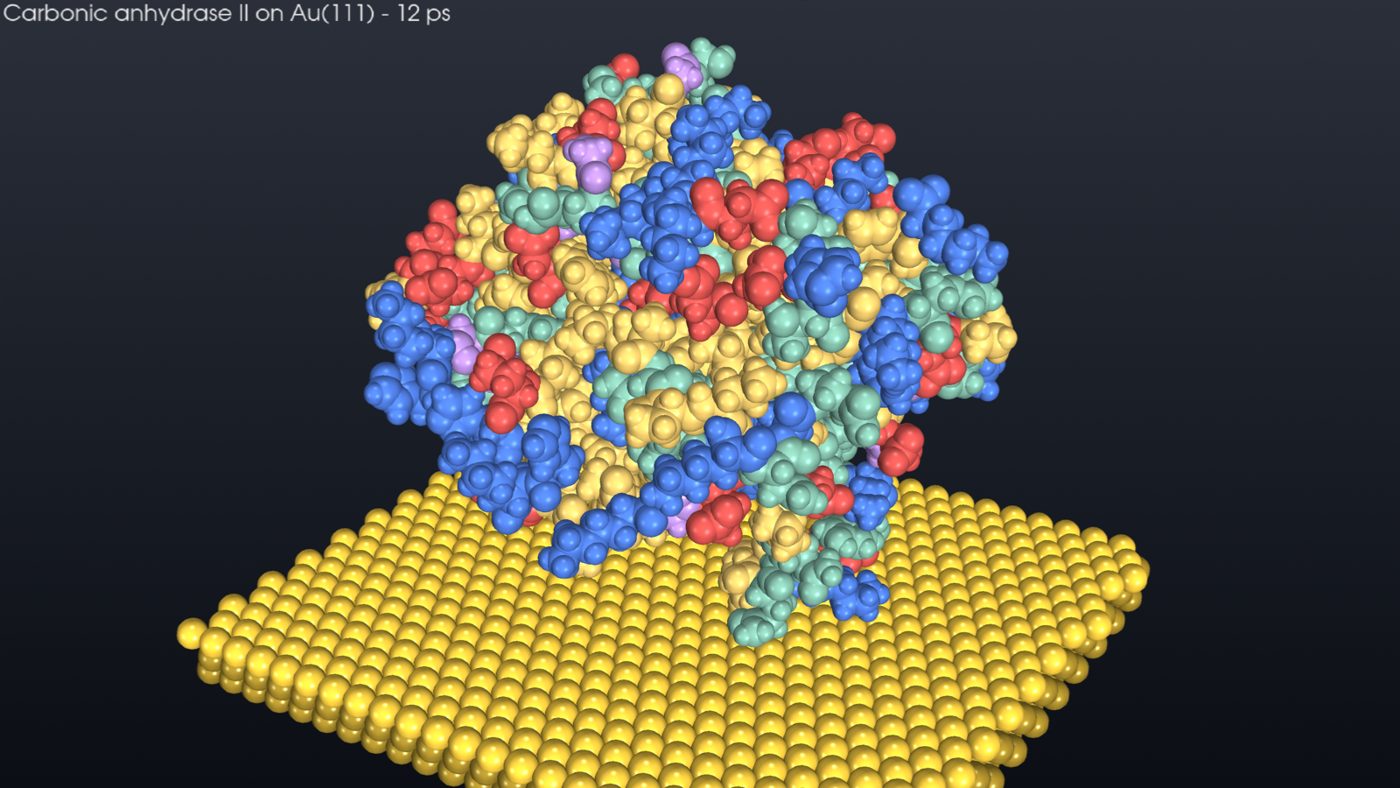
Example: carbonic anhydrase II on Au(111) with OpenMM
examples/molecular/protein_on_gold.py protein.pdb --ps 12 runs these steps:
- Repair the structure with pdbfixer.
- Orient it on the surface and build an Au(111) slab under its footprint.
- Set up Amber14 with GBn2 implicit solvent. Gold acts on every protein atom through the INTERFACE Lennard-Jones parameters (σ = 2.629 Å, ε = 5.29 kcal/mol; Heinz et al. 2008), summed over the lattice as a Steele 10-4-3 wall.
- Minimise, then run Langevin dynamics at 300 K.
- Write stills, an MP4, the MD dashboard and a glTF scene.
The example uses a flat wall and not explicit gold atoms: on a CPU, explicit atoms inside the implicit solvent cost far more. The pictures still show the explicit slab. A run of tens of picoseconds shows thermal motion and the first contacts. It is a visualisation demonstration, not an equilibrated adsorption study. The OpenMM bridge with verified equilibration is issue #460; explicit slabs, restraints and orientation sampling are issue #461.
Result of the run in the picture: 12 ps of dynamics on 4 CPU cores (about 20 minutes).
- Temperature settles at 300 K within 4 ps. The early dip comes from the constrained degrees of freedom absorbing the initial velocities.
- The backbone RMSD rises to 1.9 Å.
- The number of atoms within 3.5 Å of the gold grows from 1 to 48 while the centre of mass barely moves: side chains reach down to the surface.
- MP4 of the trajectory, with a slow orbit and a time label.
Tests: tests/test_molecular_viz.py. They check PDB reading, slab geometry (nearest-neighbour distance a/√2 and layer
spacing for each facet), orientation, RMSD invariance to rigid motion, renders, glTF and MP4.