Modelica models as Physics AI data
pinneapple_simulation.external_solvers.modelica takes a Modelica model, written as a .mo file, to training
data and checked surrogates:
- OpenModelica compiles the model into an FMU (FMI 2.0, Co-Simulation or Model Exchange), or simulates it directly.
- fmpy runs the FMU over a parameter sweep.
- The runs become a dataset, split by run, so the test runs are parameter combinations the model never saw.
- The surrogates are trained on that dataset and checked against the physics.
| Function | What it does |
|---|---|
omc.build_fmu(models, name, out_dir, fmi_version="2.0", fmu_type="cs") |
.mo file(s) to an .fmu, via buildModelFMU |
omc.simulate_mo(models, name, stop_time, parameters=...) |
Simulates with omc and returns {variable: array} including time. Parameters are applied with -override, so nothing is recompiled |
omc.omc_available() |
Returns "local" (omc on the PATH), "docker" (the image openmodelica/openmodelica:v1.24.4-minimal, or PINNEAPPLE_OMC_IMAGE) or None |
sweep.fmu_sweep(fmu, ranges, n, stop_time, output_interval, outputs, step_size=...) |
Latin-hypercube sweep on one output grid. Returns an FMUDataset (params, time, outputs, split, save / load) |
simulate_fmu, fmu_to_upd |
One FMU run, as arrays or as a PhysicalSample |
fmi_compat.check_fmus(fmus, exporter) |
Run FMUs in every interface they offer (CS, ME) and tabulate what passed; see FMI import compatibility |
OpenModelica does not need to be installed. If Docker is available, the helpers run omc from the official image and mount only the working directory.
from pinneapple_simulation.external_solvers.modelica.omc import build_fmu
from pinneapple_simulation.external_solvers.modelica.sweep import fmu_sweep

fmu = build_fmu("LadleCooling.mo", "LadleCooling", "build/")
ds = fmu_sweep(fmu, {"k_lin": (1.5, 4.0), "d_lin": (0.15, 0.35)}, n=80, stop_time=14400,
               output_interval=120, outputs=["T_melt", "T_shell"], step_size=10.0)
train, test = ds.split(16)
Step size of Co-Simulation FMUs. A Co-Simulation FMU from OpenModelica integrates with explicit Euler on the
communication step. fmpy uses the output interval as that step, so a coarse output grid can make the FMU
inaccurate or unstable. fmu_sweep(step_size=...) simulates on the fine step and interpolates onto the output
grid. The tests include a case that fails without it.
Examples (examples/modelica/)
The models are in examples/modelica/models/:
- DrainingTank.mo: a tank with an inflow, emptying through an orifice by Torricelli's law;
- LadleCooling.mo: a hot-metal ladle as three lumped masses (melt, refractory lining, steel shell). The model
includes conduction through the lining, radiation from the slag-covered surface, and convection plus radiation
from the shell.
| Example | Result |
|---|---|
01_modelica_to_fmu.py |
FMU and omc agree within 0.13 K on the melt and 0.76 K on the shell over 4 h (fixed-step FMU against DASSL). The run is packed as a PhysicalSample |
02_ladle_surrogate.py |
MLP over 5 inputs and time, trained on 64 FMU runs and tested on 16 unseen ones: see below |
03_tank_inverse_pinn.py |
Discharge coefficient identified from 21 noisy level readings by a PINN: see below |
Surrogate of the ladle model
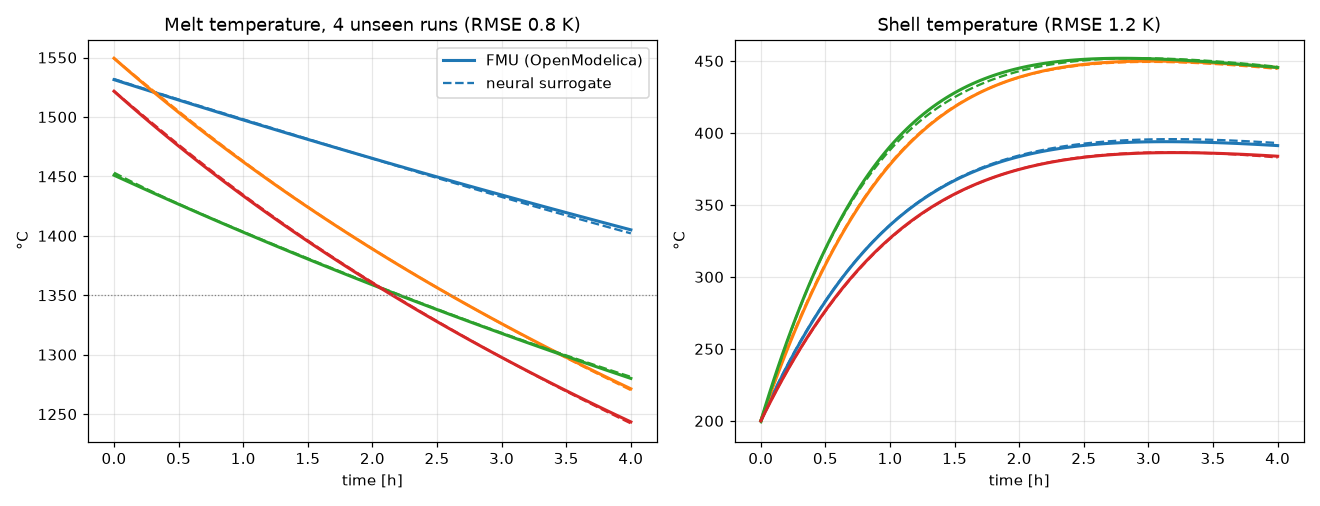
The sweep has 80 Latin-hypercube runs over five inputs: lining conductivity and thickness, surface emissivity, tapping temperature and shell convection. The trajectories last 4 h. On the 16 held-out runs:
| Neural surrogate | Nearest training run | |
|---|---|---|
| Melt temperature RMSE | 0.81 K (max 4.0 K) | 19.1 K |
| Shell temperature RMSE | 1.23 K (max 4.6 K) | 27.7 K |
| Time for the melt to reach 1350 °C, mean error | 0.6 min | 19.0 min |
| Steps where the predicted melt warms up | 0 of 1920 |
The nearest-run baseline shows how much the sweep alone gives. The physical check is that the melt never warms up in the predictions.
Discharge coefficient by a PINN
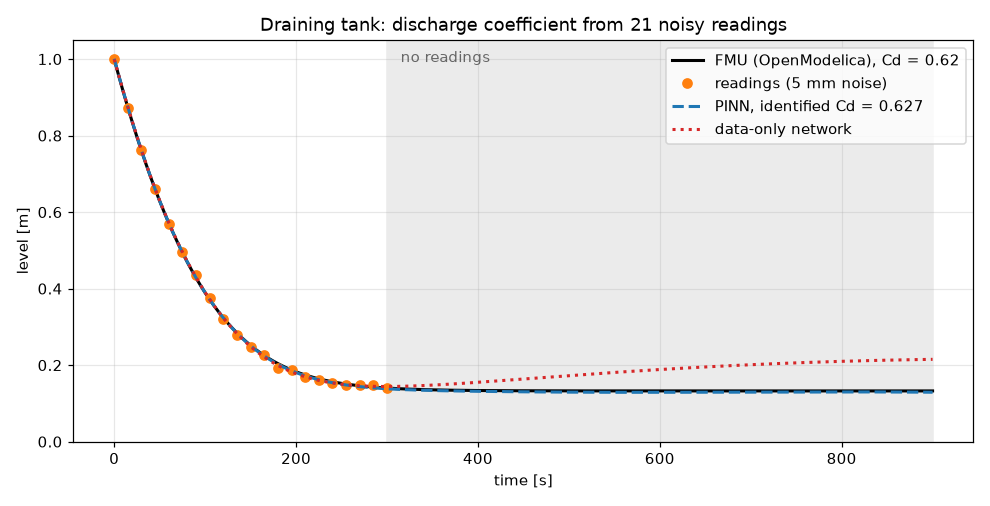
Setup. The FMU runs with the true Cd = 0.62. The readings are 21 levels over the first 300 s, with 5 mm noise. The PINN fits the readings and the mass balance A dh/dt = q_in − Cd a √(2gh) at 200 collocation points over 0–900 s, with Cd as a trainable parameter.
Results.
| Cd | Level error over 300–900 s (no readings) | |
|---|---|---|
| PINN | 0.627 (1.2 % off) | 2.9 mm |
| Finite differences on the readings, averaged | 0.628 ± 0.020 | |
| Network fitted to the readings only | 57 mm |
On Cd alone, the PINN is no better than averaged finite differences. What it adds is a level model that follows the mass balance where there are no readings.
Tests: tests/test_modelica_omc.py and tests/test_fmi_runner.py. The omc tests check the Torricelli
equilibrium, the parameter override, the sweep and the Latin-hypercube strata. They skip when neither omc nor the
Docker image is present.