Physics AI Benchmark Arena
arena.pinneapple.org · source apps/benchmark_arena
Which method works best for each physical problem, ranked under one protocol, with only numbers from runs that were actually executed.
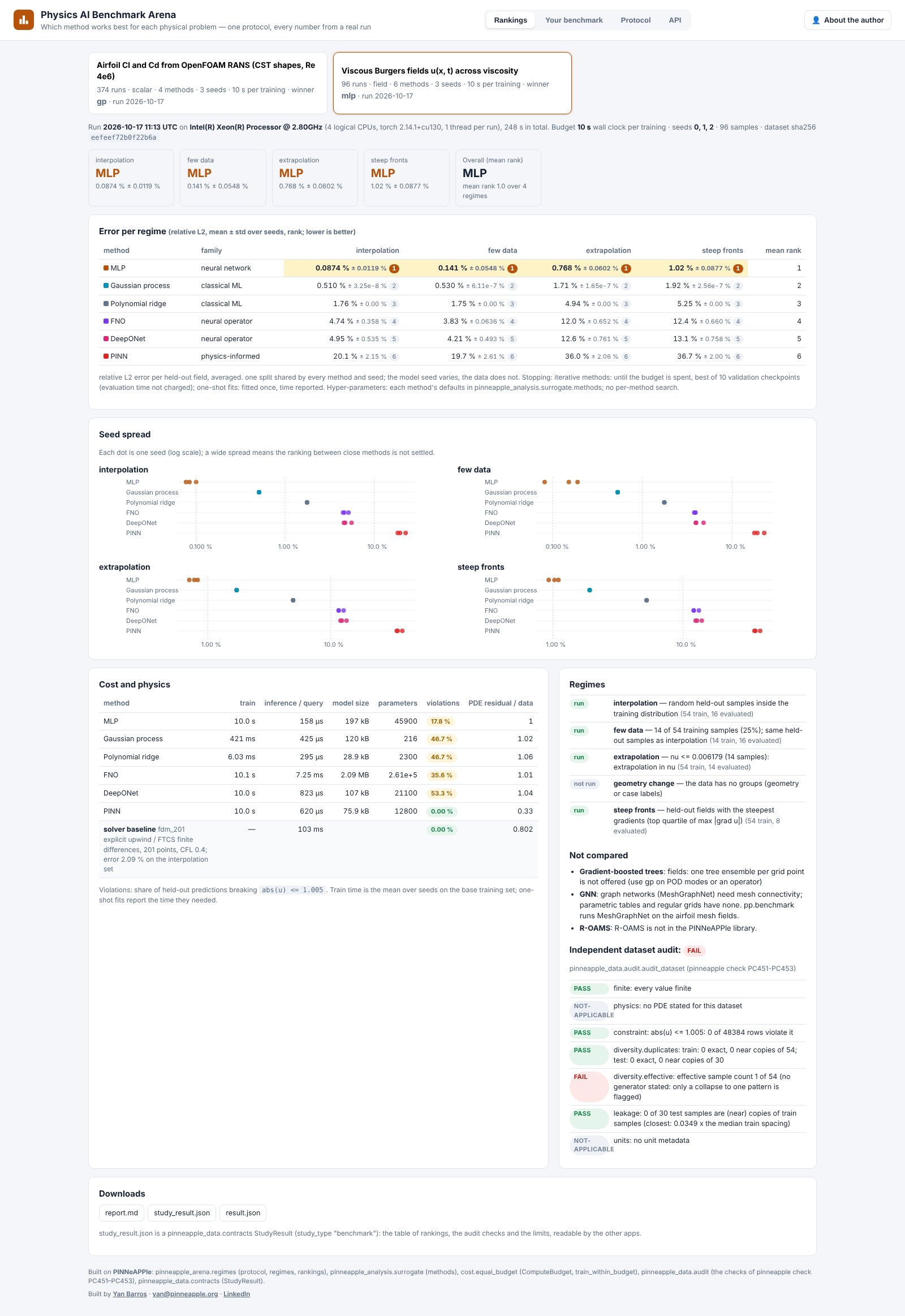
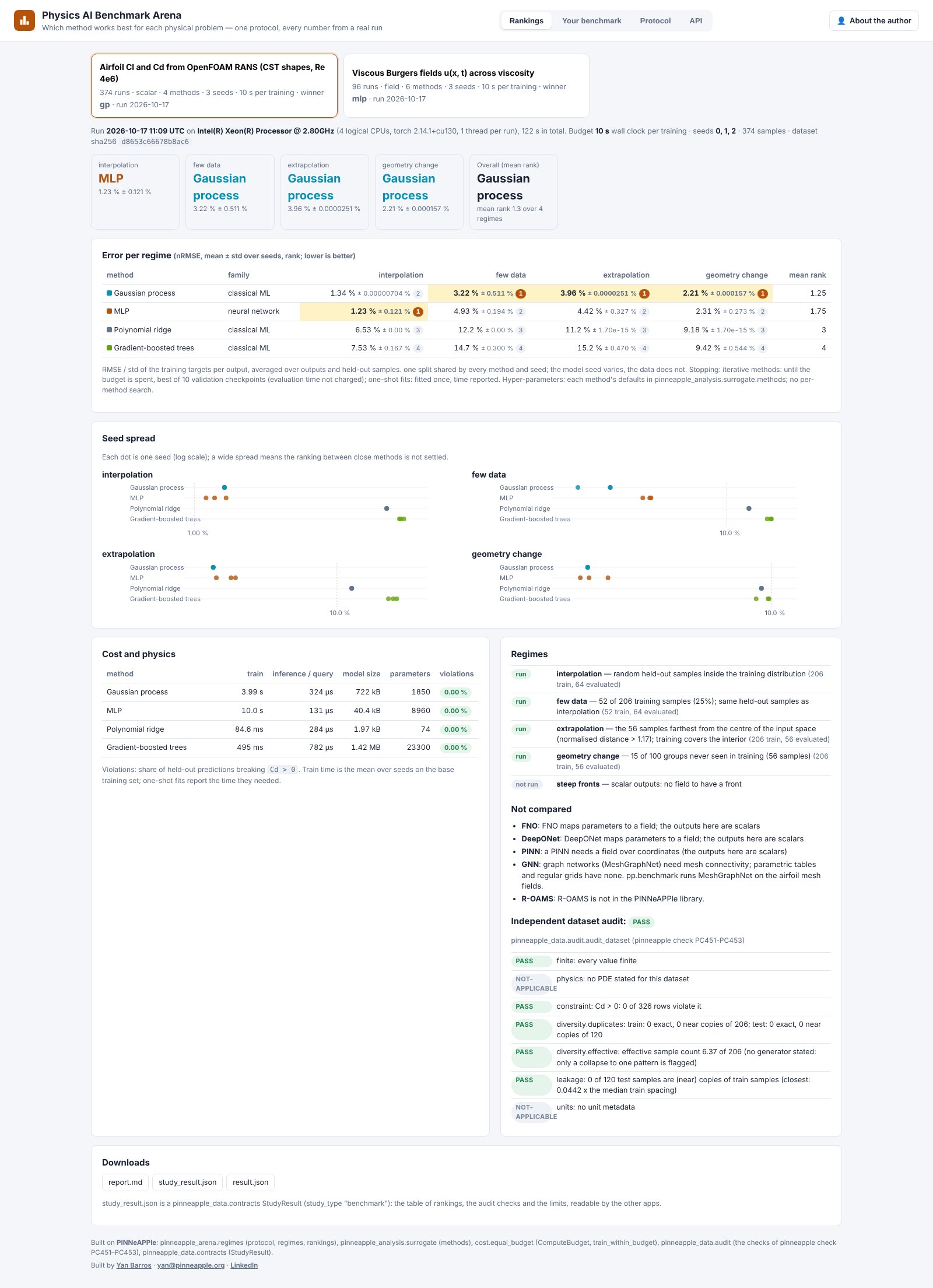
Protocol. pinneapple_arena.regimes.run_regime_arena applies the same rules to every method:
- equal data: one split for every method and seed;
- equal compute: the same
ComputeBudget, enforced bytrain_within_budget; - the same stopping rule;
- several seeds, with their spread shown;
- errors measured only on samples that no method trained on or was chosen with.
Regimes. Interpolation, few data, extrapolation, geometry change (held-out groups), and steep fronts (fields only).
Also measured. Training and inference cost, model size, violations of declared constraints, the PDE residual, and
numerical-solver baselines. The splits are audited independently by pinneapple_data.audit, which runs the dataset
checks of pinneapple check.
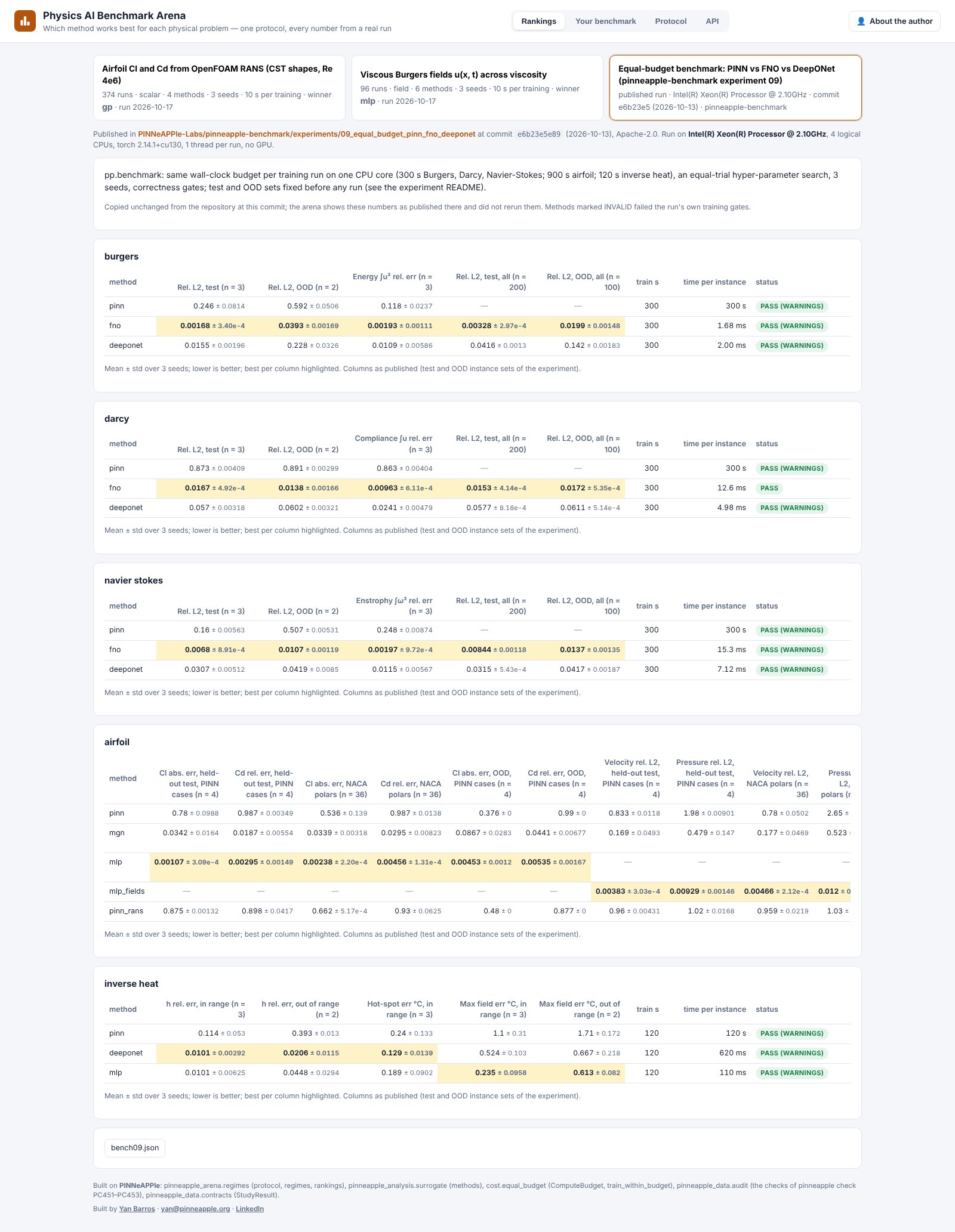
Results. Public results are files in apps/benchmark_arena/results/, written by run_public_benchmarks.py with
their date, hardware and dataset hash. The published results of pinneapple-benchmark experiment 09 (five problems, pp.benchmark
protocol) are shown unchanged with their source commit and hardware. Private benchmarks run the same protocol on an uploaded table as a job.
Library. pinneapple_arena.regimes, pinneapple_analysis.surrogate.methods,
pinneapple_analysis.cost.equal_budget, pinneapple_data.audit; guide:
Surrogates from simulation results.
Limits.
- Hyper-parameters are the library defaults; there is no per-method search.
- Wall-clock budgets depend on the hardware.
- "Steep fronts" is only a proxy for discontinuities.
- Graph networks and R-OAMS are not compared; the app states why.